
How to Buy a Home With Bad Credit in Florida 2026: Real Options, No False Hope
I’m not going to tell you bad credit is no big deal. But I am going to show you exactly what’s possible — because more is possible than you’ve been told.
Find My Path to Homeownership →Let me be real with you from the start: a lower credit score does cost you more. It may cost you a higher interest rate, a larger down payment requirement, or it may mean taking 3–6 months to improve your score before applying. I’m not going to sugarcoat that.
What I will tell you is that “bad credit” doesn’t have one fixed definition — and it definitely doesn’t mean “no mortgage.” The path to homeownership with challenged credit is real. It just requires a different kind of strategy and a lender who knows how to navigate it.
I’ve helped buyers in Central Florida get approved with scores in the 560s. I’ve helped clients with past bankruptcies close on homes within 2 years. I’ve worked with people who thought they were 5 years away from owning — and we got them in within 9 months. Here’s how.
What “Bad Credit” Actually Means for a Mortgage in 2026
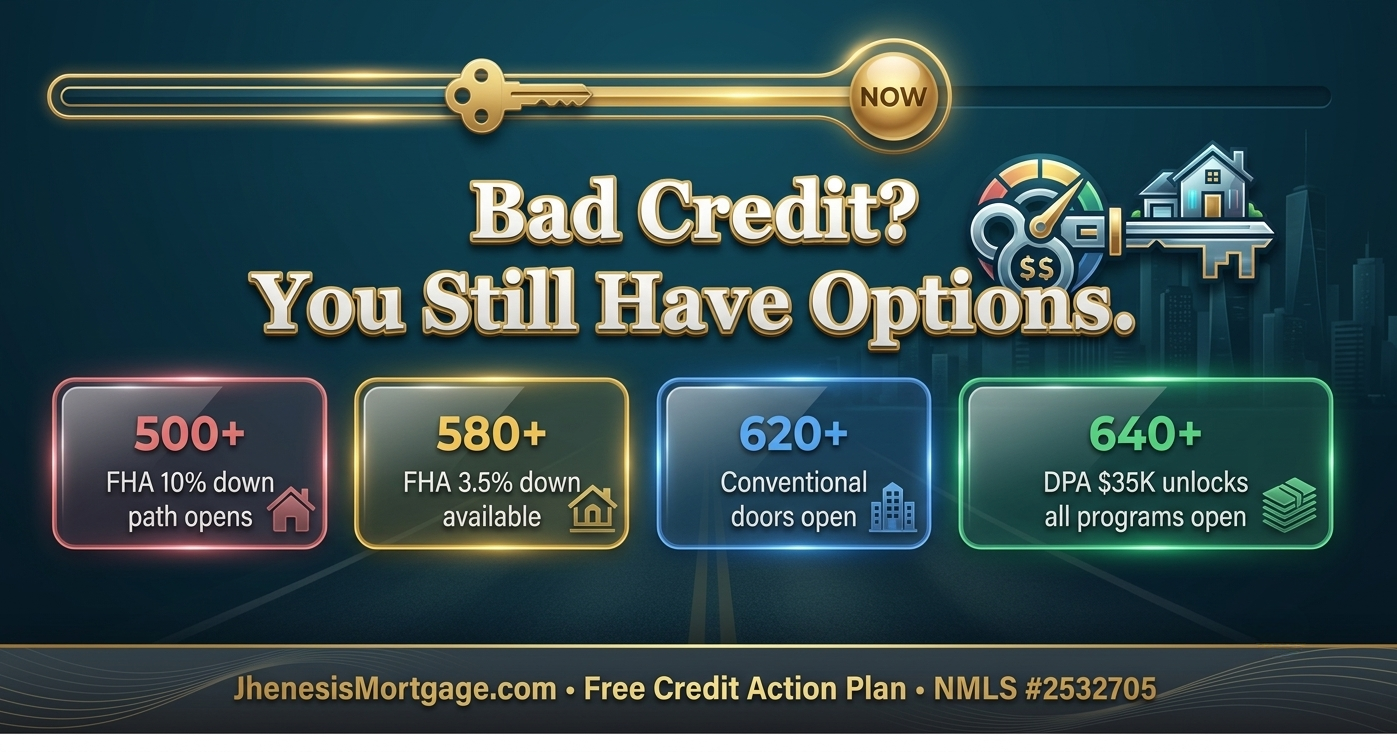
Credit score is just one piece of the puzzle. Here’s a realistic map of what each score range means for your mortgage options in Florida today:
FHA loan with 10% down is the primary path. Some non-QM lenders will consider 580+ with strong compensating factors. This range may require 3–6 months of credit work before applying. Focus on paying down balances and disputing errors immediately.
FHA 3.5% down becomes available. Some non-QM programs with 20–25% down. Down payment assistance programs typically require 640+, so a short credit improvement plan may open DPA as well. This is a very workable range.
FHA and conventional both available. Conventional PMI will be higher at this range; a side-by-side comparison often shows FHA is cheaper in the short term. Non-QM options also open at this range with standard down payments.
Full range of programs available — FHA, conventional, VA, USDA, and most non-QM products. Rate is not at peak yet but is respectable. Most down payment assistance programs are within reach. Small improvements here can move you into meaningfully better rate tiers.
All doors open. Best conventional rates, lowest PMI, all DPA programs, VA and USDA eligibility, and most non-QM programs at favorable pricing. If you’re here, your focus is optimizing the program — not qualifying for it.
Share your range (no credit pull needed) and I’ll tell you exactly what programs you qualify for today — and what’s within reach in 90 days.
Get My Free Credit Path Review →
The 5 Fastest Ways to Improve Your Credit Score Before Applying
Credit improvement isn’t as slow as people think if you know which levers to pull. These are the strategies I walk through with every client who comes to me before they’re ready to apply:
1. Pay Down Credit Card Balances (Biggest Single Impact)
Credit utilization — how much of your available credit you’re using — makes up 30% of your FICO score. If your cards are above 30% utilized, paying them down can move your score 20–50 points within one billing cycle. Ideally, get each card below 10% utilization before applying.
2. Dispute Errors on Your Credit Report
Pull your free reports from AnnualCreditReport.com. Studies show roughly 1 in 5 reports contain errors significant enough to affect a score. Late payments that belong to someone else, closed accounts showing as open, incorrect balances — dispute all of it. Corrections can reflect within 30–45 days.
3. Become an Authorized User
If a family member has a credit card with a long history, high limit, and clean payment record — ask to be added as an authorized user. Their positive history can reflect on your report and boost your score, sometimes within one billing cycle. You don’t even need to use the card.
4. Don’t Open New Credit or Close Old Accounts
New credit applications create hard inquiries (small score drops) and reduce your average account age. Closing old accounts removes available credit and increases utilization. Do neither for at least 90 days before applying for a mortgage.
5. Address Collections Strategically
Paying off old collections doesn’t always improve your score — especially under older FICO models. More recent scoring models (FICO 9, VantageScore) do reward paid collections. Know which model your lender uses before paying a collection. Sometimes, a goodwill letter requesting deletion is more effective than payment.
🎯 Credit Action Plan Finder
Answer 3 questions and I’ll tell you the single most important thing to do with your credit right now before applying for a mortgage.
What is your estimated current credit score?
What’s your biggest credit challenge right now?
When do you want to buy?
Non-QM Options When Your Credit Is Challenged but Your Finances Are Solid
One thing most buyers don’t realize: credit score and financial health are not the same thing. I work with clients regularly who have a 580 credit score but $80,000 in savings, strong consistent income, and zero financial risk to a lender — they just have a few old collection accounts dragging their score down.
For those borrowers, non-QM programs can sometimes offer better options than FHA. Some non-QM credit event programs will work with scores as low as 580–600 with a larger down payment (20–25%) and strong compensating factors: stable income, cash reserves, low debt relative to income.
This is where having a mortgage broker — rather than a bank loan officer — makes a real difference. I have access to dozens of lenders with different guidelines. If one says no, there’s often another with a program designed for exactly your situation.
Frequently Asked Questions
Your Credit Score Is a Starting Point, Not a Verdict
Tell me where you are today and I’ll show you what’s possible now — and what’s possible in 90 days with a focused action plan. No judgment. No credit pull for the initial review.
Book My Free Credit + Mortgage Strategy Call →Stacy Ann Stephens | Mortgage Broker | NMLS #1933745 | Jhenesis Mortgage NMLS #2532705 | 407-630-9766 | stacyann@jhenesismortgage.com
Informational only. Not a commitment to lend. Credit score improvement results vary. All loans subject to underwriting approval. Not all borrowers qualify.