
Can My Common Law Partner Help Me Get a VA Loan in Florida?
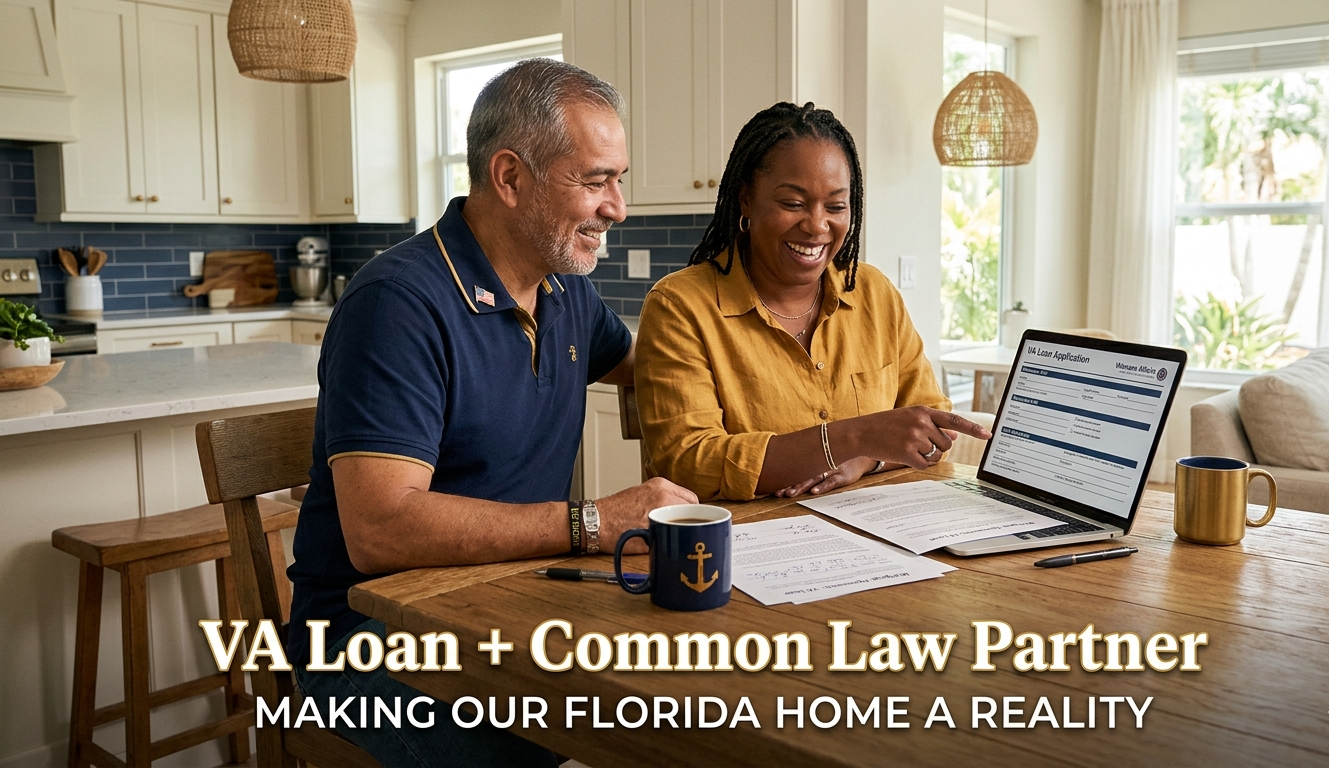
She has the better credit. You have the VA benefit. You’ve been together for years. But in Florida, “common law marriage” isn’t a thing — and that changes everything about how your VA loan works.
Talk to a VA Loan Specialist — FreeThis is one of the most common questions I hear from veterans and service members: “We’ve been together for years. She has better credit than me. Can’t she just help me get this VA loan?”
The answer depends on one thing most people don’t realize upfront: Florida does not recognize common law marriage. Period. Florida abolished it in 1968. No matter how long you’ve been together, how many children you have, or how you’ve been presenting yourselves as a couple — in Florida’s eyes, you are not legally married unless you have a marriage license and ceremony.
And the VA cares about legal marriage. So let’s break down every scenario so you know exactly where you stand.
Scenario 1: You’re Legally Married (Most Straightforward)
✅ Legally Married Veteran + Spouse
What’s available: Full VA loan with 100% VA guaranty, zero down payment option. Your spouse can be added as a co-borrower. Both incomes count. Both credit profiles are reviewed by the lender — and here’s the nuance: lenders use the lower middle score of all borrowers on the loan to set the rate and qualify the file.
What this means: If you have a 720 FICO and your spouse has a 640 FICO, the lender qualifies the loan using the 640. Adding a spouse with significantly lower credit can hurt your rate or approval — even on a VA loan. In that scenario, it may be smarter for the veteran to apply solo and only count their own income.
If your spouse has BETTER credit: Great news. Adding a co-borrowing spouse with higher credit doesn’t directly raise the qualifying score (lenders still use the lowest middle score), but their income increases what you can borrow. And if their credit is higher than yours, you may want to explore which borrower’s score drives the pricing.
Scenario 2: Unmarried Partner — What Actually Happens
⚠️ Veteran + Unmarried Non-Veteran Partner
The category: This is called a “joint VA loan.” The VA’s Lender’s Handbook Chapter 7 defines this as when a veteran applies with someone who isn’t their legal spouse. The rules change significantly.
The core problem: The VA only guarantees the veteran’s portion of the loan — typically 50% on a jointly-held property. The non-veteran’s portion is unguaranteed. Lenders treat the non-veteran’s share like a conventional loan — which usually means a down payment is required on that portion.
Math example: On a $400,000 purchase split 50/50 between a veteran and an unmarried non-veteran partner, the VA guarantees 25% of the veteran’s $200,000 share = $50,000. The non-veteran’s $200,000 has no backing. Most lenders require roughly 12.5% down on the non-veteran’s share = ~$25,000 down payment. Zero-down is gone.
The credit question: Yes, your partner’s income can help you qualify for a larger loan — but the lender still uses the lowest middle score, just like with a married couple. If her credit is better, it helps with the income side but doesn’t automatically pull up the score used for pricing.
Important: Not all VA lenders offer joint VA loans. Work with a broker who specifically has access to lenders who do.
Scenario 3: Two Veterans Buying Together
✅ Veteran + Veteran Co-Borrower
Two veterans buying together can each use a portion of their entitlement. In many cases this eliminates the down payment issue because both portions are VA-backed. Options include using all of one veteran’s entitlement and saving the other’s, splitting entitlement evenly, or combining remaining entitlement from prior VA loans. Two-veteran purchases have more flexibility — but still require both borrowers to intend to occupy the property as a primary residence.
Do You Need to Get Married?
That’s the real question — and it depends on what you’re trying to achieve. Here’s the honest breakdown:
| Goal | Without Marriage | With Marriage |
|---|---|---|
| Zero down payment | Not available in joint VA loan | Full zero-down available |
| Use partner’s income to qualify | Yes — income counted | Yes — income counted |
| Partner’s credit affects loan | Yes — lowest score used for pricing | Yes — same rule |
| Full VA guaranty | VA only guarantees veteran’s portion | Full VA guaranty on entire loan |
| VA Funding Fee | Applies to veteran’s portion | Applies unless disability exempt |
| Partner on title | Yes, both on title | Yes, both on title |
| Property rights if relationship ends | No automatic protections in FL | Full divorce / equitable distribution rights |
There’s no “right” answer — only the answer that fits your situation. Some couples decide the zero-down advantage is worth moving up the wedding timeline. Others put 12.5% down and move forward as a joint VA loan. Others have the veteran apply solo, qualify on their own income, and keep the partner’s finances separate.
What Are Florida’s VA Loan Requirements Beyond the Relationship Question?
Let’s make sure the full VA loan picture is clear — because there are several requirements veterans ask about:
| VA Loan Requirement | Detail |
|---|---|
| Certificate of Eligibility (COE) | Required. Documents your service history and VA entitlement. Your lender can usually pull it electronically within minutes. |
| Minimum Credit Score (VA) | VA sets no minimum — but most lenders require 580–620 minimum, with 680+ for best rates |
| Primary Residence Requirement | Must occupy the property as primary residence. VA loans are not for investment properties or vacation homes. |
| VA Funding Fee | Most borrowers pay a one-time funding fee (typically 2.15%–3.3% for first use, 3.6% for subsequent use). Veterans with a service-connected disability rating of 10%+ are exempt. |
| Property Condition (MPRs) | The property must meet VA Minimum Property Requirements. The VA will order an appraisal that checks for safety, soundness, and sanitation. |
| Loan Limits | With full entitlement, there is no loan limit — you can borrow as much as your income and credit qualify for without a down payment. With partial entitlement, county conforming limits apply. |
| Bankruptcy / Foreclosure | Chapter 7: 2-year wait from discharge. Chapter 13: may qualify after 12 months of on-time payments with court approval. Foreclosure: typically 2-year wait. |
| Florida Insurance Note | Florida homeowners insurance costs are among the highest in the nation and directly affect your VA loan qualification and monthly payment. Budget carefully. |
🎖️ VA Loan Scenario Finder
Tell us about your situation and we’ll explain exactly which VA loan path applies — and what your options look like.
Every veteran’s VA loan situation is different. Let’s map out your specific path before you apply anywhere.
Book Your Free VA Loan Strategy CallFrequently Asked Questions
No. Florida abolished common law marriage in 1968 (Florida Statute §741.211). No matter how long you’ve been together, Florida does not treat an unmarried couple as legally married — and the VA recognizes marriage under the law of the state where you reside or where you were married. If you’re in Florida and want a full spousal VA loan, you need a legal marriage license. One exception: if you validly established a common law marriage in a state that recognizes it before moving to Florida, Florida and the VA will honor that marriage.
Yes — but it’s classified as a “joint VA loan,” not a standard VA purchase. The key tradeoffs are: (1) VA only guarantees the veteran’s portion of the loan, so the lender typically requires a down payment on the non-veteran’s portion, (2) not all VA lenders offer joint loans — you need to find one that does, and (3) both borrowers must intend to occupy the property as their primary residence. Their income can help you qualify for more, but the zero-down benefit is reduced or eliminated.
Not in the way most people expect. VA lenders (and virtually all lenders) use the lowest middle credit score among all borrowers on the loan to set the qualifying rate and terms. If your partner has a 720 and you have a 640, the lender qualifies the file using your 640 — even if she’s on the loan. Adding her helps on the income side (more qualifying income = larger loan), but doesn’t pull your credit score up. If your credit is significantly lower, it may actually be smarter to apply solo and just use your income, then add her to the title after closing.
There are meaningful risks that often go undiscussed. First, if the relationship ends and the non-veteran partner keeps the home, the veteran’s VA entitlement remains tied up until the loan is paid off, refinanced into a non-VA product, or the home is sold. That can block the veteran from using VA benefits again for years. Second, Florida does not give automatic property rights to unmarried partners — ownership follows title, not the relationship. Third, a joint VA loan creates joint liability — if one person stops paying, the other must cover the full payment. Every unmarried couple buying together should consult a real estate attorney and sign a co-ownership agreement before closing.
The VA Funding Fee is a one-time fee that helps sustain the VA loan program. For first-time VA loan users with no down payment, the fee is 2.15% of the loan amount (as of 2026). For subsequent use, it’s 3.6%. If you put 5%+ down, it drops to 1.5%; 10%+ down reduces it to 1.25%. Veterans with a service-connected disability rating of 10% or greater are completely exempt from the funding fee — and this exemption can be worth thousands. Always confirm your disability rating status before closing so you don’t pay a fee you’re not required to pay.
Yes — an unmarried surviving spouse of a veteran who died in service or from a service-connected disability may independently qualify for VA loan benefits. This requires a separate Certificate of Eligibility (VA Form 26-1817) and qualification through the VA’s surviving spouse eligibility process. Surviving spouses who remarried after age 57 and on or after December 16, 2003 may still retain this eligibility. This is a separate and important benefit path — speak with a VA-approved lender familiar with surviving spouse files.
Yes, if you want the full zero-down benefit on the entire loan and you’re in Florida. With a legal spouse, the entire loan is VA-backed and zero-down is available on the full purchase price. With an unmarried partner, the VA only backs the veteran’s portion — and the non-veteran’s share typically requires a down payment of around 12.5% of that portion. If zero-down on the full purchase price is essential and your partner needs to be on the loan, legal marriage is the path that gets you there in Florida.
Your VA Benefit Is One of the Most Powerful Financial Tools Available. Let’s Use It Right.
Whether you’re buying solo, with a spouse, or with an unmarried partner, I’ll help you understand exactly what you can access — and structure it so your VA benefit works as hard as possible for you.
Book Your Free VA Loan Strategy CallCall or text: 407-630-9766
Stacy Ann Stephens | Mortgage Broker | NMLS #1933745 | Jhenesis Mortgage NMLS #2532705
VA loan eligibility, entitlement, and benefit rules are determined by the U.S. Department of Veterans Affairs and may change. Florida marriage law information is general in nature and does not constitute legal advice — consult a Florida-licensed family law attorney for guidance on your specific situation. This content is for educational purposes only and is not a commitment to lend.