
Zero Down in Florida? USDA Loans 2026 — And the Cities That Qualify Might Surprise You
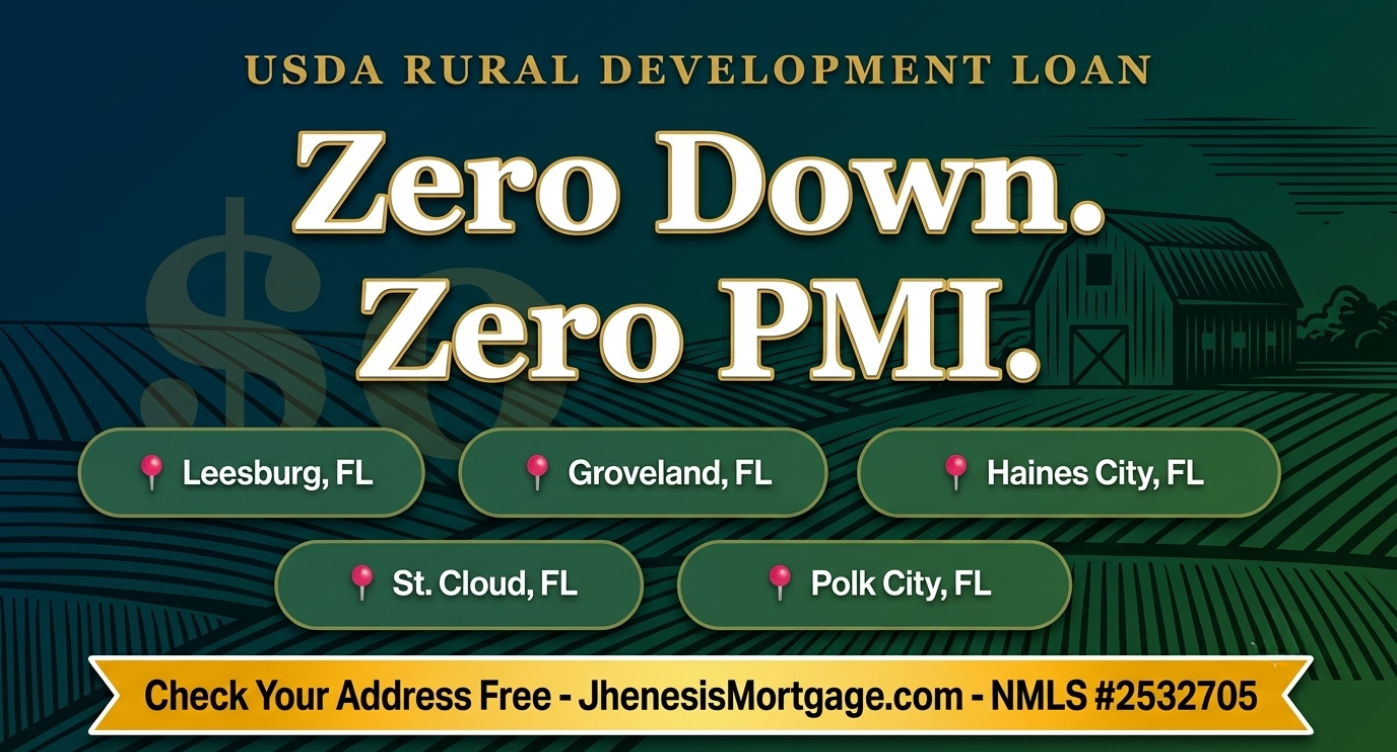
You don’t have to live in a cornfield to qualify for a USDA loan. Leesburg, Groveland, St. Cloud, Haines City — these are real Central Florida markets with real USDA eligibility.
Check My USDA Eligibility Free →I hear this a lot: “Oh, USDA? That’s for farms, right?” Not even close. The USDA Rural Development Guaranteed Loan Program is one of the most underutilized mortgage programs in Florida — and in my experience, it’s also one of the most powerful for buyers who qualify.
Zero down payment. No private mortgage insurance. Competitive rates. And more Florida zip codes qualify than you’d ever expect.
What Is a USDA Loan, Exactly?
A USDA loan is a government-backed mortgage issued through the U.S. Department of Agriculture’s Rural Development program. There are two main types — the Direct Loan (for very low-income borrowers) and the Guaranteed Loan (for moderate-income borrowers through approved lenders like Jhenesis Mortgage). This guide focuses on the Guaranteed Loan, which is what most buyers use.
| Feature | USDA Guaranteed Loan 2026 |
|---|---|
| Down Payment | 0% — Zero required |
| Mortgage Insurance | Annual fee: 0.35% (much lower than FHA MIP at 0.55%) |
| Upfront Guarantee Fee | 1% of loan amount — can be financed into the loan |
| Minimum Credit Score | 640 typical (some lenders accept 620 with manual underwriting) |
| Income Limit | 115% of area median income — varies by county and household size |
| Property Eligibility | Must be in a USDA-designated eligible area |
| Property Type | Single-family primary residence only (no investment properties) |
| Loan Limits | No official cap — determined by income, DTI, and appraisal |
| Seller Concessions | Up to 6% of purchase price toward closing costs |
| Gift Funds | Allowed for closing costs |
Florida Areas That Qualify for USDA in 2026 (You May Be Surprised)
USDA eligibility is determined by the property address — not the city name. Many suburban and growing communities within the Greater Orlando, Tampa Bay, and Jacksonville metro areas contain USDA-eligible parcels, even if the city itself sounds urban. Here are Central Florida examples I work with regularly:
How to check any address: Use the official USDA Property Eligibility Map at eligibility.sc.egov.usda.gov — or simply message me and I’ll check it in 60 seconds.
I’ll run the USDA eligibility check for free — takes less than 2 minutes.
Check My Address Free →
USDA Income Limits in Central Florida 2026
The USDA income limit is based on your total household income — everyone who lives in the home — not just the borrower on the loan. The limit is set at 115% of the area median income for your county and household size. This is often significantly higher than people expect.
| County | 1–4 Person Household | 5–8 Person Household |
|---|---|---|
| Lake County (Leesburg / Groveland) | ~$112,450 | ~$148,450 |
| Osceola County (St. Cloud) | ~$118,550 | ~$156,500 |
| Polk County (Haines City / Davenport) | ~$103,500 | ~$136,650 |
| Volusia County (Daytona area) | ~$103,500 | ~$136,650 |
| Orange County (some eligible pockets) | ~$118,550 | ~$156,500 |
*Income limits are approximate and updated annually by USDA. Contact Jhenesis Mortgage for current figures specific to your county and household size. NMLS #2532705.
USDA vs. FHA vs. Conventional: Which Costs Less?
Here’s a comparison most people never see — especially the annual mortgage insurance difference between USDA and FHA:
| Feature | USDA | FHA | Conventional 5% Down |
|---|---|---|---|
| Down Payment | 0% | 3.5% | 5% |
| Upfront Fee | 1% (financed) | 1.75% (financed) | None |
| Annual MI Rate | 0.35% | 0.55% | ~0.7% (varies) |
| MI Duration | Life of loan | Life of loan (<10% down) | Cancels at 20% equity |
| Min Credit Score | 640 | 580 | 620 |
| Property Restriction | Eligible areas only | None | None |
| Investment Property | No | No | Yes (higher rate) |
On a $280,000 purchase with zero down, USDA’s annual fee of 0.35% adds about $817/year ($68/month) to your payment. FHA on the same loan amount at 0.55% MIP adds about $1,276/year ($106/month). That’s a $38/month difference — real savings that compound over the life of the loan.
🌾 USDA Zero-Down Payment Estimator
See exactly what your monthly payment looks like on a USDA loan — including the annual guarantee fee — with zero money down.
*Includes P&I + annual guarantee fee (0.35%). Does not include taxes, homeowner’s insurance, or HOA. Upfront 1% guarantee fee is financed into the loan. Rates estimated. Contact Jhenesis Mortgage for current USDA rates. NMLS #2532705. Not a commitment to lend.
Who Is the Ideal USDA Buyer?
USDA loans work best for:
- First-time buyers with limited savings — Zero down payment removes the biggest barrier to homeownership
- Moderate-income households — If your income is under the county limit, USDA often beats both FHA and conventional on total cost
- Buyers flexible on location — Willingness to look in Leesburg, Groveland, or Haines City instead of downtown Orlando opens a world of USDA-eligible inventory
- Buyers with 640+ credit — USDA’s credit requirements are accessible without being rock-bottom
- New construction buyers — Many new subdivisions in USDA-eligible areas offer move-in-ready homes — check eligibility before touring
Let me check the property eligibility AND run your income against the current limits. Five minutes can tell you whether zero-down is possible in your target neighborhood.
Check My USDA Eligibility Free →
Frequently Asked Questions
Zero Down Is Real — and It May Be Available in Your Neighborhood
Let me check USDA eligibility for your target area and run your income against the current limits. Five minutes can tell you whether USDA is your path to homeownership with no money down in 2026.
Check My USDA Eligibility Free →
Stacy Ann Stephens | Mortgage Broker | NMLS #1933745 | Jhenesis Mortgage NMLS #2532705
407-630-9766 | stacyann@jhenesismortgage.com | JhenesisMortgage.com
Informational purposes only. USDA income limits and eligible areas subject to change annually. Not a commitment to lend. All loans subject to credit approval, income verification, and property eligibility. Not all borrowers will qualify.