
Mortgage Without Tax Returns? What 12 Months of Bank Statements Can Actually Prove
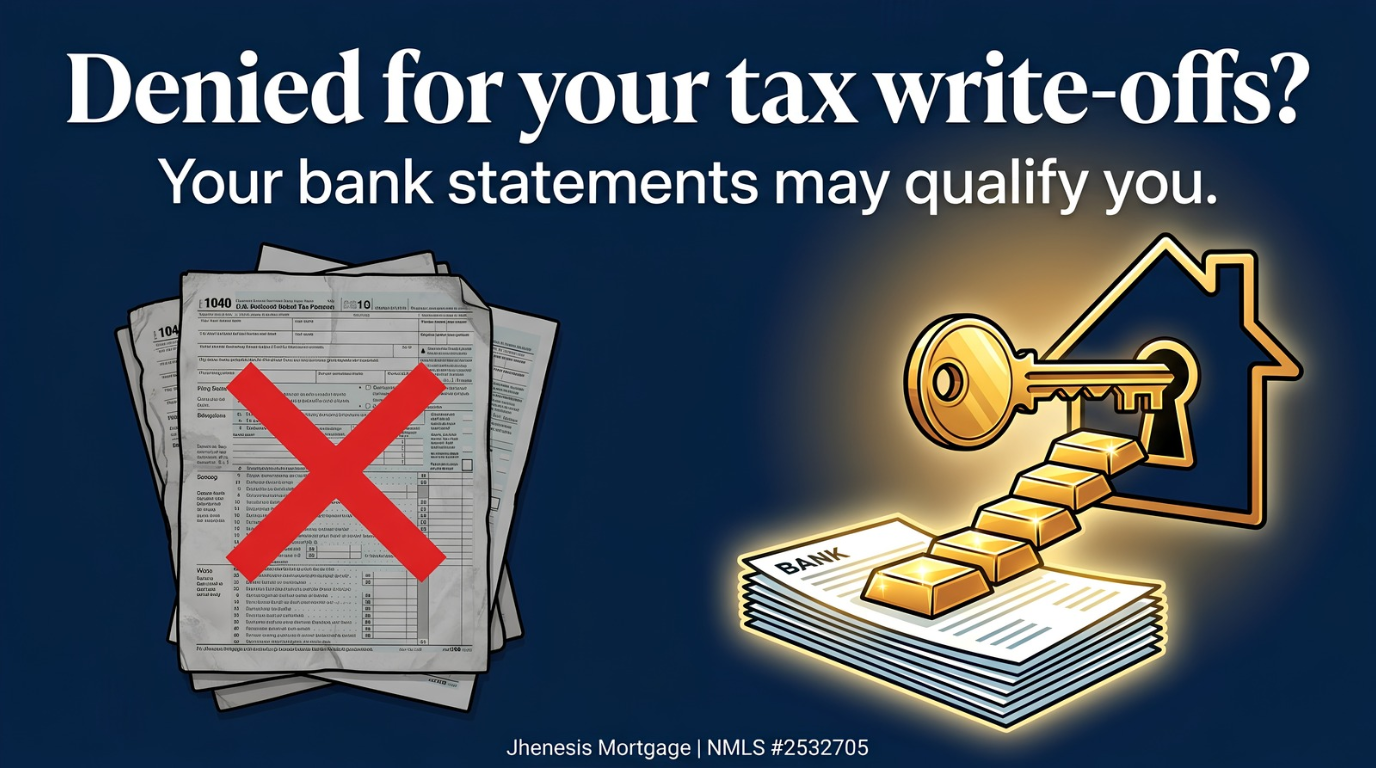
Your tax return shows what you kept. Your bank statements show what you earned. Here is how lenders can use the second one.
You have probably heard some version of this: “Your business is doing great, but your tax return doesn’t show it.”
You did nothing wrong. You paid your people, wrote off the truck, the software, the home office, and everything the tax code allows. That is smart business. And then a bank looks at the bottom line of your return and decides you earn a fraction of what really lands in your account.
It is exhausting, and it can feel personal. I want you to know it is not. It is just one lender’s way of reading one document. There are other documents, and one of the best is the one you already have: your bank statements.
Can I get a mortgage with 12 months of bank statements and no tax returns?
- Yes. A bank statement loan uses 12 or 24 months of personal or business statements as your income proof.
- It is a non-QM mortgage, which means it falls outside the standard rules used for conventional loans.
- You are still fully reviewed: credit, assets, debts, and the property all matter.
What it is: a mortgage where your income is calculated from the money flowing into your accounts, instead of the bottom line of your tax return.
What it does for you: it removes the penalty for smart tax planning. A freelancer, contractor, consultant, agent, or small business owner who writes off aggressively can show the income they really earn.
| Feature | What it means for you |
|---|---|
| Uses bank statements, not tax returns | Your qualifying income reflects real cash flow, not after-write-off profit |
| 12 or 24 month options | You can choose the window that shows your income best |
| Personal or business accounts | Works for solo operators and incorporated owners alike |
| Fully underwritten | You get a real approval, not a shortcut that falls apart later |
If this sounds like your situation, start a quick scenario review and I will tell you in one conversation whether it fits.
How do lenders turn bank statements into qualifying income?
- They add up eligible deposits and divide by the number of months to get an average.
- For business accounts, they apply an expense factor and your ownership percentage.
- They remove transfers, loan proceeds, and one-time deposits that are not real income.
Think of it as a simple three-step recipe. Start with total deposits, remove anything that is not income, and then adjust for business expenses. The result is your monthly qualifying income.
The expense factor is the part that surprises people. Business statements show gross deposits, not profit, so lenders often apply a flat expense percentage. A CPA-prepared profit and loss statement can sometimes support a different ratio. Personal statements usually skip this step because they already reflect money you can spend.
Bank Statement Income Estimator
An educational estimate, not an approval. Programs and expense factors vary by lender.
Is a non-QM mortgage safe, and what will it really cost?
- Yes, when it is from a licensed lender and you understand the terms. Non-QM is not the same as predatory or subprime.
- Federal rules still require the lender to verify you can repay the loan.
- The trade-off is usually a higher rate or cost than a conventional loan.
I hear the worry all the time: “Is this one of those risky loans?” Here is the clear version. QM stands for qualified mortgage, a set of standard rules that give lenders extra legal protection. Non-QM simply means the loan does not fit those exact boxes, usually because income is verified differently. It is still a regulated, fully documented loan, and the lender must still make a good-faith determination that you can afford it.
What changes is price and flexibility. Because the lender takes on a less standardized loan, the rate and fees are usually higher than conventional. For the right borrower, that cost buys something valuable: the approval you could not get any other way, on a property you might otherwise lose.
- Benefit: approval based on your real income. Feature behind it: alternative documentation.
- Benefit: keep your tax strategy. Feature behind it: no tax returns required.
- Benefit: a path to refinance later. Feature behind it: you can move to a conventional loan once your returns catch up.
My rule: if your tax returns qualify you, I will tell you to compare conventional first, because it is usually cheaper. If they do not, a bank statement loan is a legitimate and powerful tool, not a last resort.
Not sure which side of that line you are on?
Send me a few months of statements. I will tell you plainly what you qualify for and what it would cost.
Start My Scenario ReviewBook a Free CallWhich no-tax-return loan fits me?
- Bank statement loans fit most self-employed borrowers buying or refinancing a home.
- P&L-based programs fit owners with a CPA and clean books.
- DSCR loans fit investors who want the property’s rent to qualify, not personal income.
| If this sounds like you | Often the best fit | What you usually provide |
|---|---|---|
| I own a business with its own bank account | Business bank statement loan | 12 or 24 months of business statements |
| I am a freelancer or gig worker with one personal account | Personal bank statement loan | 12 or 24 months of personal statements |
| I have a CPA and clean books | P&L-based program, at lenders that offer it | CPA-prepared profit and loss, sometimes with statements |
| I am buying or refinancing a rental | DSCR loan | Lease or market rent report, not personal income |
| I am W-2 with a 1099 side hustle and strong returns | Compare conventional first | Tax returns and W-2s |
| I do not have a Social Security number or live abroad | ITIN or foreign national program | Program-specific documents |
Your Bank Statement Readiness Checklist
Tap each item as you finish it. The bar fills as you go.
0 of 7 complete
Have most of these? Send them over for a free review.
Frequently Asked Questions
Can I get a mortgage with 12 months of bank statements without showing tax returns?
Yes. Bank statement loans are non-QM mortgages that calculate your income from 12 or 24 months of personal or business bank statements instead of tax returns. The lender still fully underwrites you, reviewing credit, assets, debts, and the property.
How much of my bank deposits count as income?
It depends on the statements. With personal statements, most eligible deposits can count. With business statements, lenders apply an expense factor, often a flat percentage unless a CPA-prepared profit and loss statement supports a different one, and they adjust for your ownership share. Transfers, loan proceeds, and one-time deposits are generally excluded.
Should I choose 12 or 24 months of bank statements?
Use whichever period shows your income most accurately. Twelve months can be enough and is faster to document. If your income is seasonal or grew recently, the lender may average 24 months, and your broker can compare which period qualifies you for more.
Is a bank statement loan risky or subprime?
No. Non-QM does not mean subprime. These loans are fully underwritten and still follow the federal ability-to-repay rule, which requires the lender to verify that you can afford the payment. They simply verify income a different way than a tax return.
What credit score and down payment do I need for a bank statement loan?
Requirements vary by lender and program. Many programs look for a credit score in the mid-600s or higher and a down payment starting around 10 percent, with stronger scores and larger down payments earning better pricing. Your broker can check the current guidelines for your profile.
How long do I need to be self-employed to qualify?
Most programs want about two years of self-employment in the same field, though some accept a shorter history if you have prior experience in the industry. Ask early, because this is one of the first things an underwriter checks.
Do bank statement loans have prepayment penalties?
On loans for a home you will live in, federal rules generally restrict prepayment penalties on non-QM mortgages. Investor and business-purpose loans, such as DSCR, often do carry them. Always ask for the terms in writing.
Will I pay a higher interest rate with a bank statement loan?
Often yes. Because the loan is non-QM, the rate and costs are usually higher than a conventional loan. If your tax returns show enough income, conventional may cost less, so the right move is to compare both.
Can I use personal bank statements if my business and personal money are mixed?
Often yes. Lenders may accept personal statements if they show business income deposited there, and some programs allow a mix. A clean separation between business and personal accounts makes the file simpler and faster.
You do not have to prove yourself to a tax form
You built something real. Let’s show a lender what it looks like in your own bank statements. No pressure, no jargon, just a straight answer and a plan.
Start My Scenario ReviewCall or Text 407-630-9766