
3-2-1 Buydown Mortgage Loans: Lower Your Payment for the First 3 Years
What if your mortgage payment started lower than what the rate actually says — and gradually stepped up to full payment over your first three years? That’s not magic. It’s the 3-2-1 buydown, and it’s one of the smartest tools on the market right now for buyers navigating a higher-rate environment.
Here’s the thing about today’s market: rates are elevated compared to where they were just a few years ago, and buyers are feeling the payment pressure. Sellers — especially new construction builders — know this. And smart sellers are using the 3-2-1 buydown as a seller-paid incentive to bridge the gap between what a buyer can afford today and what the market demands.
I’ve been getting a lot of questions about this lately, and I want to break it down completely — how it works, who pays for it, whether it makes more sense than buying permanent points, and when it’s the right move for you. Plus, I built a payment schedule calculator at the bottom of this page so you can see your exact numbers in real time.
What Is a 3-2-1 Buydown and How Does It Work?
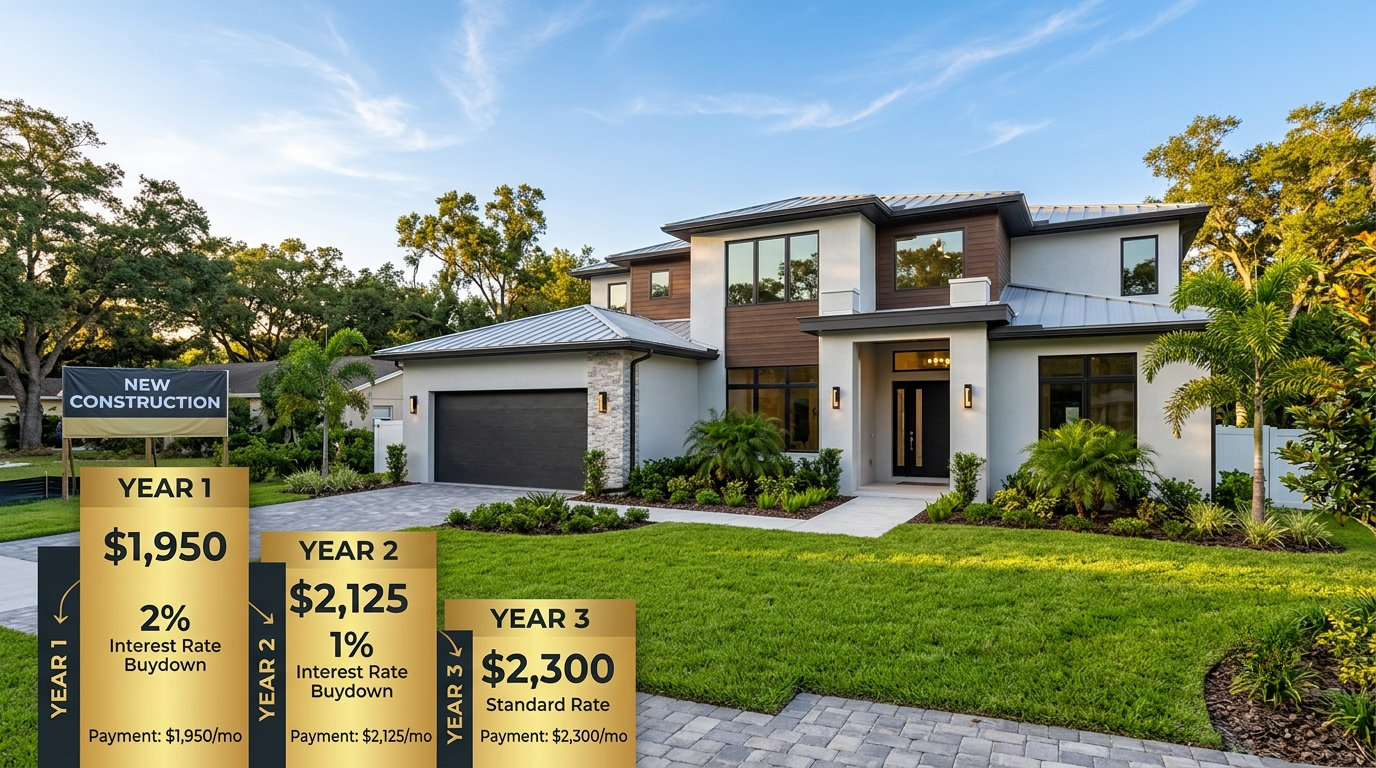
A 3-2-1 buydown is a temporary interest rate reduction that lowers your effective mortgage rate for the first three years of your loan. After that, your rate reverts to the permanent note rate on your loan for the remaining term.
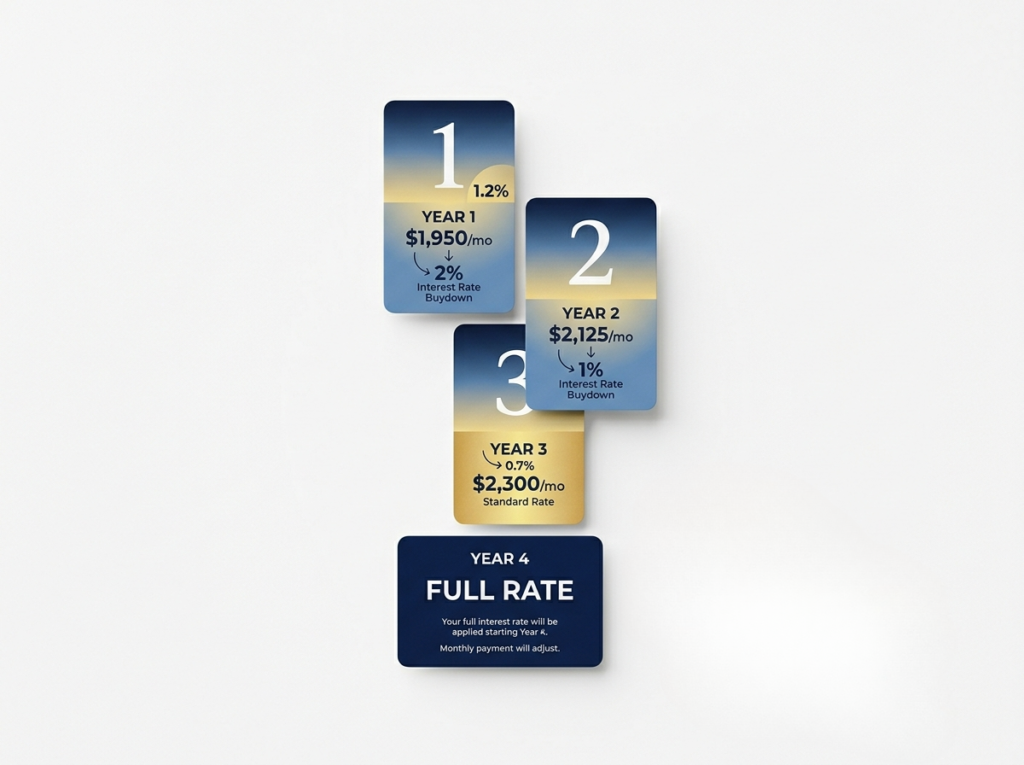
The structure is simple: your rate is reduced by 3% in year one, 2% in year two, and 1% in year three. Beginning in year four, you pay the full note rate you locked in at closing — for the life of the loan.
3-2-1 Buydown Rate Structure
Here’s a concrete example. Say you’re buying a home and your locked note rate is 6.875%:
- Year 1: You pay at 3.875% — significantly lower payment
- Year 2: You pay at 4.875% — still below market
- Year 3: You pay at 5.875% — close to full rate
- Year 4–30: You pay at 6.875% — the rate you actually locked in
Important distinction: The 3-2-1 buydown does NOT change your actual mortgage rate. Your note rate stays the same for the life of the loan. What changes is how much of the interest you pay directly — the difference is funded by an upfront payment (the buydown cost) held in escrow and applied each month to make up the gap.
Want to see your 3-2-1 buydown payment schedule?
Use the calculator below — or let me run the exact numbers for your purchase.
Get a Free Rate Quote →Who Pays for the Buydown — and Why Sellers Love This Tool
This is where it gets interesting — and where today’s market creates a real opportunity for buyers.
The 3-2-1 buydown costs money. Specifically, it requires an upfront deposit (often called a “buydown fund” or “subsidy”) placed in an escrow account at closing. That fund is drawn down monthly to make up the difference between your reduced payment and the actual interest owed.
The cost of a 3-2-1 buydown is roughly 1.5–3% of the loan amount, depending on the note rate and loan term. On a $400,000 loan, that might be $6,000–$12,000.
Option 1: The Seller Pays (Most Common)
In today’s market — especially with new construction homes — sellers and builders are frequently offering 3-2-1 buydowns as an incentive to close deals. Instead of lowering the sale price (which affects their comparable sales), they fund the buydown. This costs them roughly the same but gives you a lower payment for three years — which is often more valuable to a buyer than a price reduction.
Option 2: The Builder Pays
Many Central Florida builders — especially in communities like Celebration, Lake Nona, and Winter Garden — are actively promoting builder-funded buydowns. When you see “rates as low as X%” in a new construction community, they’re often referring to a builder-paid temporary buydown. The rate advertised is year one; your permanent rate is higher. Know what you’re actually looking at.
Option 3: The Buyer Pays
You can also fund the buydown yourself — though this is less common. If you have cash reserves and prioritize lower payments in the early years (perhaps because you’re expecting income growth or a refinance opportunity), buyer-funded buydowns are available.
Pro tip: When negotiating a seller concession, ask for it to be applied specifically to a 3-2-1 buydown rather than just closing costs. This converts a seller credit into three years of meaningful payment relief — and you still close with lower or zero out-of-pocket costs if structured correctly.
📅 3-2-1 Buydown Payment Calculator
See your year-by-year payment schedule and total savings vs. paying full rate
| Period | Effective Rate | Monthly P&I | vs. Full Rate | Monthly Savings |
|---|
P&I only. Does not include taxes, insurance, or PMI. Actual buydown cost varies by lender. Consult Jhenesis Mortgage for a complete Loan Estimate.
3-2-1 vs. 2-1 Buydown vs. Permanent Points — Which Is Right for You?
A buydown is not your only option for managing payment in a high-rate environment. Here’s how the three main approaches compare:
| Strategy | Rate Reduction | Duration | Best For | Seller Can Pay? |
|---|---|---|---|---|
| 3-2-1 Buydown | 3% yr1 / 2% yr2 / 1% yr3 | 3 years, then full rate | Buyers expecting income growth or refi in 3–5 yrs | ✓ Yes |
| 2-1 Buydown | 2% yr1 / 1% yr2 | 2 years, then full rate | Buyers wanting shorter adjustment window; lower cost | ✓ Yes |
| Permanent Points | ~0.25% per point paid | Life of the loan | Long-term homeowners staying 7+ years; better math long-term | Sometimes |
The bottom line on choosing: If you genuinely plan to stay in the home for 10+ years and don’t anticipate refinancing, permanent discount points may have a better long-term ROI. If you’re in the “buy now, refi later” mindset — or if the seller is paying — the 3-2-1 buydown gives you immediate relief with no long-term commitment. The 2-1 buydown is a middle ground: lower cost, shorter relief window.
When a 3-2-1 Buydown Makes Sense — and When It Doesn’t
It Makes Sense When…
- The seller or builder is funding it. If someone else is paying for your lower payments in years 1–3, the math is almost always in your favor — as long as you can comfortably afford the full payment in year 4.
- You’re expecting income growth. If you’re early in your career, your business is scaling, or you’re anticipating a meaningful raise in the next few years, the graduated payment structure works with your trajectory.
- You plan to refinance. If rates drop in the next 3–5 years and you refinance before year 4, you capture the discounted payments and refinance before full-rate exposure. This is not guaranteed — but for buyers in a high-rate environment, it’s a reasonable expectation to plan around.
- You’re buying new construction in a motivated market. New construction builders have margin to absorb buydown costs. This is where the deal-making is strongest.
It Doesn’t Make Sense When…
- You can’t afford year 4 payment. The buydown gives you time, not a rate reduction. If you cannot qualify for or comfortably afford the full payment, the buydown is not a solution — it’s a delay.
- You’re paying for it yourself and staying forever. If you’re funding the buydown and plan to stay in the home long-term with no refinance, permanent discount points will likely save you more money over time.
- The purchase price is inflated to cover the buydown cost. Always verify the appraised value. Some sellers inflate the price to “fund” the buydown — meaning you’ve paid for it anyway, hidden inside the purchase price.
The question to ask your broker: “Show me the full payment in year 4. Can I qualify for that payment today, and is it within my budget?” If the answer to either question is no, we need a different strategy — and there are plenty.
Let’s structure your offer the right way
Whether it’s a 3-2-1 buydown, seller concessions, or a different strategy — I’ll find the approach that makes the most sense for your specific situation.
Call (407) 630-9766 for a Strategy SessionFrequently Asked Questions
A 3-2-1 buydown is a temporary interest rate reduction applied to your mortgage for the first three years. Your effective interest rate is reduced by 3% in year one, 2% in year two, and 1% in year three. In year four and beyond, you pay your full locked note rate for the remaining life of the loan. The difference between the reduced payments and actual interest is covered by an upfront buydown fund paid at closing — typically by the seller or builder.
Most commonly, the seller or builder pays for the 3-2-1 buydown as a purchase incentive. The cost — typically 1.5% to 3% of the loan amount — is deposited into an escrow account at closing and drawn down monthly. Buyers can also fund the buydown themselves, though this is less common when sellers are motivated to offer concessions.
After the three-year buydown period, your payment adjusts to reflect your actual note rate — the rate you locked in at closing — for the remaining 27 years of a 30-year loan. This is a predictable, fixed payment. The 3-2-1 buydown is not an adjustable-rate mortgage; your rate was always fixed. The buydown simply reduced the portion you paid directly in the early years.
It depends on your time horizon. Discount points permanently lower your rate for the life of the loan, making them better for long-term homeowners who stay 7+ years without refinancing. A 3-2-1 buydown provides larger payment relief upfront but reverts to the full rate in year four. If the seller is funding the buydown and you expect to refinance within 5 years, the 3-2-1 buydown typically wins. If you’re buying to stay and paying out of pocket, permanent points may provide better long-term value.
The 3-2-1 buydown is available on conventional fixed-rate loans and most FHA fixed-rate loans. It is not available on adjustable-rate mortgages (ARMs), VA loans as a standard product (though VA does allow some temporary buydown structures), or USDA loans. The program must be applied to a fixed-rate product. Contact Jhenesis Mortgage to confirm availability for your specific loan program.
A 3-2-1 buydown reduces your rate by 3% in year one, 2% in year two, and 1% in year three — providing three full years of relief before full rate kicks in. A 2-1 buydown reduces by 2% in year one and 1% in year two — only two years of relief. The 2-1 buydown costs less to fund and is simpler to negotiate, but provides less total savings. The 3-2-1 is more powerful when sellers are willing to contribute, especially in new construction markets.
Ready to Put a 3-2-1 Buydown to Work for You?
Whether you’re buying new construction or negotiating with a motivated seller, I’ll show you exactly how to structure this — and make sure the math actually works in your favor before you sign anything.
Learn how a 3-2-1 buydown can lower your payment for 3 years.
Apply Now →