
Retiring or Living on Fixed Income? How to Buy, Refinance, or Access Equity Without a Paycheck
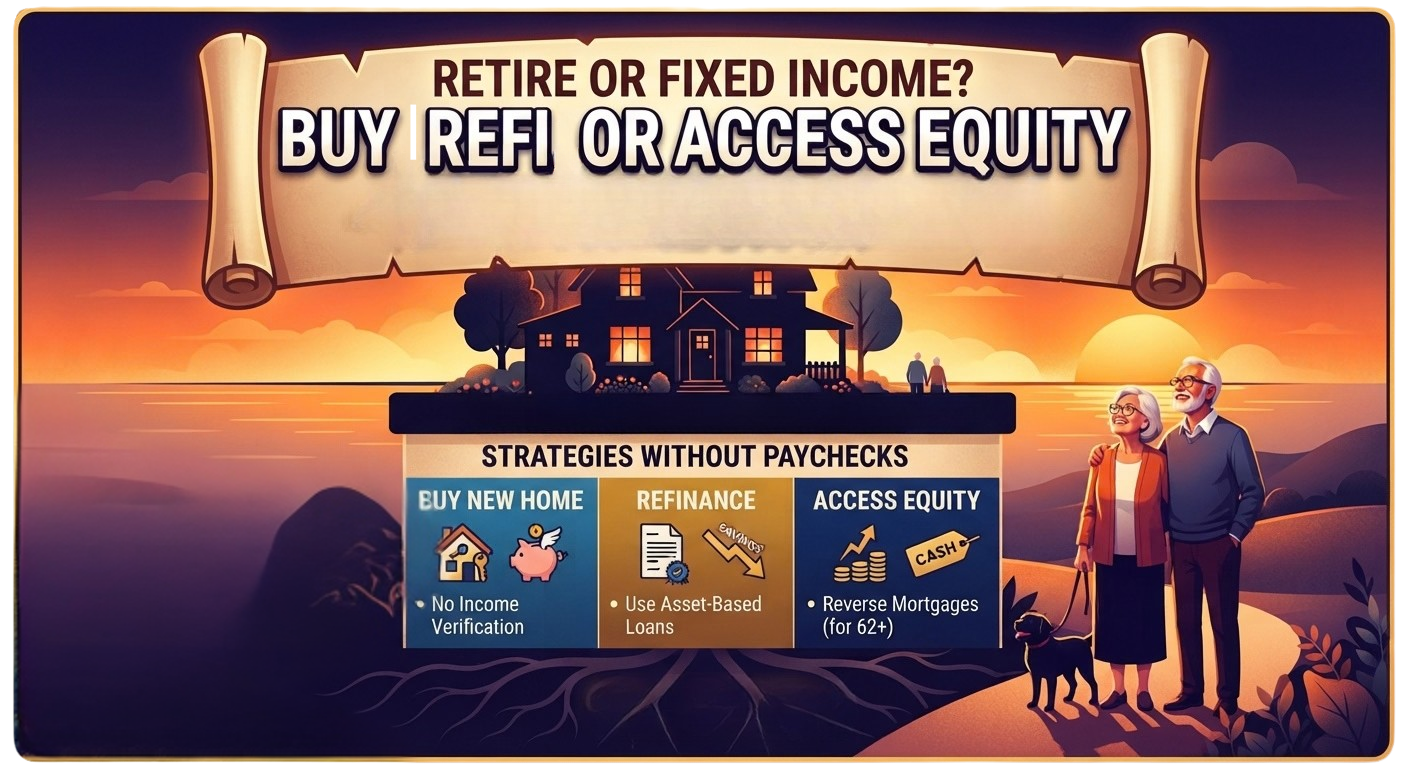
No paycheck doesn’t mean no options. Here’s how retirement income, assets, and timing all factor into buying, refinancing, or accessing your home’s equity.
“I don’t have a paycheck anymore” is one of the most common things we hear from people approaching or already in retirement — usually said as if it settles the question of whether a mortgage is still possible. It doesn’t. Lenders have specific, well-established ways to count retirement income, and for people with strong assets but modest monthly income, there’s an entire loan category built around exactly that gap.
Whether you’re buying a smaller home for retirement, refinancing to lower a payment on a fixed income, or thinking about accessing the equity in a home you’ve owned for decades, the path forward depends on understanding what actually counts as qualifying income once the paychecks stop.
Here’s how Social Security, pensions, retirement account distributions, and even your assets themselves can qualify you — plus the moves worth making before you fully retire, while your W-2 income is still on the books.
Approaching retirement and thinking about your housing plans?
Whether it’s downsizing, refinancing, or simply understanding your options before you stop working, let’s map out what your retirement income and assets actually qualify you for — before the timing gets harder to work with.
Plan My Retirement Housing MoveWhat Actually Counts as Income in Retirement
| Income Source | How It’s Typically Counted |
|---|---|
| Social Security | Counted as income, often “grossed up” since it’s usually not taxed — meaning it can count for more than its face value in qualifying calculations |
| Pension / Annuity | Counted as income if it’s verified to continue for a minimum period, typically documented via an award letter |
| Retirement Account Distributions (401k, IRA) | Counted if distributions have begun and are documented as likely to continue, or the account itself can qualify via asset-depletion (below) |
| Rental Income | Counted using standard rental-income documentation, same as for any landlord |
| Part-Time or Consulting Income | Counted like any self-employment or part-time income, generally with some history to document it |
If Your Income Looks Modest But Your Assets Don’t
This is one of the most common — and most solvable — situations we see with retirees: someone who spent decades building a substantial retirement portfolio, but whose monthly income on paper looks thin because they haven’t started drawing it down yet, or don’t want to. An asset-depletion loan (sometimes called asset-utilization) is built for exactly this. Instead of requiring you to actually withdraw and spend down your retirement accounts, the lender calculates a qualifying monthly income figure based on your eligible liquid assets divided over a set term — letting your net worth do the qualifying work your monthly cash flow can’t.
Asset Income Estimator
A simplified illustration of how eligible assets can convert to qualifying income. Actual program terms vary.
Timing: Do This Before You Fully Retire, If You Can
If retirement is planned rather than already underway, there’s real value in handling any mortgage purchase, refinance, or HELOC while you’re still employed. W-2 or steady self-employment income is generally the most straightforward to document, and locking in favorable terms before your income structure changes gives you more options, not fewer. Once you’ve fully retired, you’re not without options — see everything above — but the documentation shifts, and it’s simply easier to move before the transition than after.
HECM and HECM for Purchase, Simply Explained
For homeowners 62 or older, a Home Equity Conversion Mortgage (HECM) — the FHA-insured reverse mortgage — allows equity to be converted into funds without a required monthly mortgage payment, with the loan repaid when the home is sold, the borrower moves out permanently, or passes away. A HECM for Purchase applies the same concept to buying a new home — using a combination of down payment and the reverse mortgage to purchase without a monthly mortgage payment going forward. Both require mandatory HUD-approved counseling before closing, which is a genuinely useful step, not just a formality — it ensures the decision fits your full financial and estate picture. This is a significant, long-term decision that deserves an unhurried conversation, not a rushed one.
Let’s map your retirement housing options together.
Whether it’s Social Security and pension income, an asset-depletion loan, or exploring a HECM, we’ll walk through what actually qualifies you — clearly, and without pressure.
Schedule My Retirement Planning CallRetirement & Mortgage: Common Questions
Can Social Security alone qualify me for a mortgage?
It can be counted as income, and because it’s typically not taxed, many programs allow it to be “grossed up” — counted at a higher value than its face amount — which can meaningfully help your qualifying numbers. Whether it’s enough on its own depends on the loan amount and your full financial picture.
What is an asset-depletion loan and how is it different from just using retirement savings as a down payment?
An asset-depletion (or asset-utilization) loan converts a portion of your eligible liquid assets into a calculated monthly qualifying income figure — without requiring you to actually withdraw or spend the money. It’s a qualifying method, not a spend-down requirement, which is the key difference from simply using savings as a down payment.
Is it better to refinance before or after I retire?
If retirement is planned and a refinance is something you’re considering anyway, doing it before your income structure changes is generally simpler to document. Once retired, you still have solid options — Social Security, pension, and asset-depletion among them — but the earlier move often has fewer moving parts.
What’s the difference between a regular reverse mortgage and a HECM for Purchase?
A standard HECM lets you access equity in a home you already own without a required monthly payment. A HECM for Purchase applies the same structure to buying a new home, combining a down payment with reverse mortgage proceeds so there’s no ongoing monthly mortgage payment on the new home either.
Do I need HUD counseling for a HECM, and is it just a formality?
Yes, HUD-approved counseling is required before closing on any HECM, and it’s genuinely useful — it walks through how the loan affects your finances, your estate, and your long-term plans, not just a box to check before approval.