

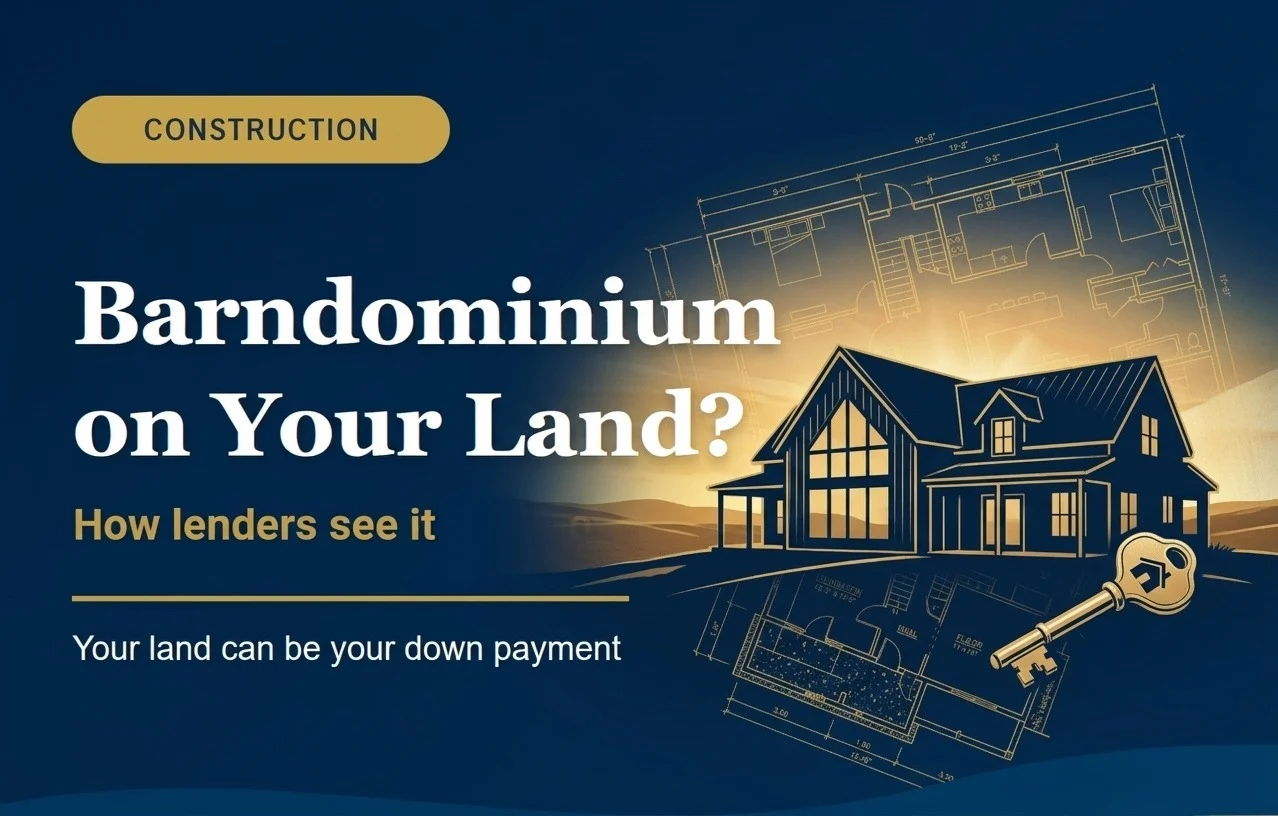
Barndominium Loan: How to Finance Building on Land You Already Own (Even If You Are Self-Employed)
You have the land and the dream. Lenders have questions about steel, foundations and comps. Here is how to get ready for them.
You own the land. You have a vision of the barndominium, the shop, the porch, the open living space. And then you start calling lenders and hear the same thing: “We are not sure how to finance that.”
That reaction is not about you. Barndominiums sit between a standard house and a metal building, and many lenders do not have a clear box for them. The ones who do will ask good questions, and the borrowers who have the answers ready are the ones who get approved.
If you own your land and you are self-employed, you are closer than you think. Here is how the financing works and what to prepare.
Own land and planning a barndo?
Send me your lot, your builder and your rough budget. I will tell you what lenders will ask and how your land helps.
Review My Barndominium PlanWhy Barndominiums Confuse Lenders
A barndominium is a living space built in a barn-style structure, often with a metal frame, a large open floor plan and sometimes an attached shop. To an underwriter, three things stand out:
- Comparable sales are thin. There may be few nearby sales to support the value, which is the appraiser’s biggest challenge.
- Construction details vary. Kit builds, shell-only builds and custom builds are not treated the same.
- Use of the space matters. A true residence is different from a shop with living quarters.
The fix is preparation. A clear plan from an experienced builder, a thorough budget, and a lender who finances this type of build remove most of the doubt.
How Your Land Becomes Your Down Payment
If you own the lot free and clear, its value can often count as your equity contribution. Instead of writing a big check, you pledge the land. Lenders typically compare the loan to the total project cost and to the finished appraised value, and each program sets its own limits.
Land Equity and Project Budget Calculator
Estimates only. Your lender sets the actual limits.
Want your numbers checked by a lender who finances these builds? Start a scenario review
What Lenders Want to See Before They Say Yes
- A complete budget and plans from a licensed, insured builder with a track record, and a contract that matches the budget.
- A permanent foundation and a build that meets local building code and permitting.
- Zoning and site details: utilities, septic or sewer, well or public water, access, and flood zone status.
- An appraisal that supports the finished value, which is why detailed plans and specs matter.
- Insurance that can be bound on the finished structure. In Florida, ask early about wind and flood coverage for your location.
If You Are Self-Employed
Being self-employed does not rule you out. Bank statement and P&L-based programs can calculate income from your actual deposits or a CPA-prepared profit and loss statement, which often tells the real story better than tax returns after write-offs. Have 12 to 24 months of business or personal statements ready, and be prepared to explain any large or irregular deposits.
A good first step is a short conversation before you sign a builder contract. Lender requirements can change what you ask your builder for, and that is much easier to fix before the contract than after.
Ready to build on your land?
Let’s map your financing before you sign the builder contract. One conversation can save weeks.
Schedule My Construction ConsultationBarndominium Loans: Common Questions
Can I finance a barndominium on land I already own?
Yes, in many cases. A construction-to-permanent loan can fund the build, and the equity in your land can count toward your down payment, subject to the lender’s limits.
Do barndominiums appraise lower than regular homes?
Not automatically. The challenge is often a lack of comparable sales. Detailed plans, specifications and a strong builder help the appraiser support the value.
Can a self-employed borrower get a barndominium loan?
Often yes. Bank statement and P&L-based programs can qualify self-employed borrowers using deposits or CPA-prepared financials instead of tax returns alone.
Do I need a general contractor?
Most lenders require a licensed, insured builder with a contract. Owner-builder arrangements are harder to finance, so ask before you plan around one.
Is a barndominium treated like a house or a metal building?
If it is a true residence on a permanent foundation that meets code, many lenders treat it as a single-family home. A shop with living quarters can be treated differently, so details matter.