

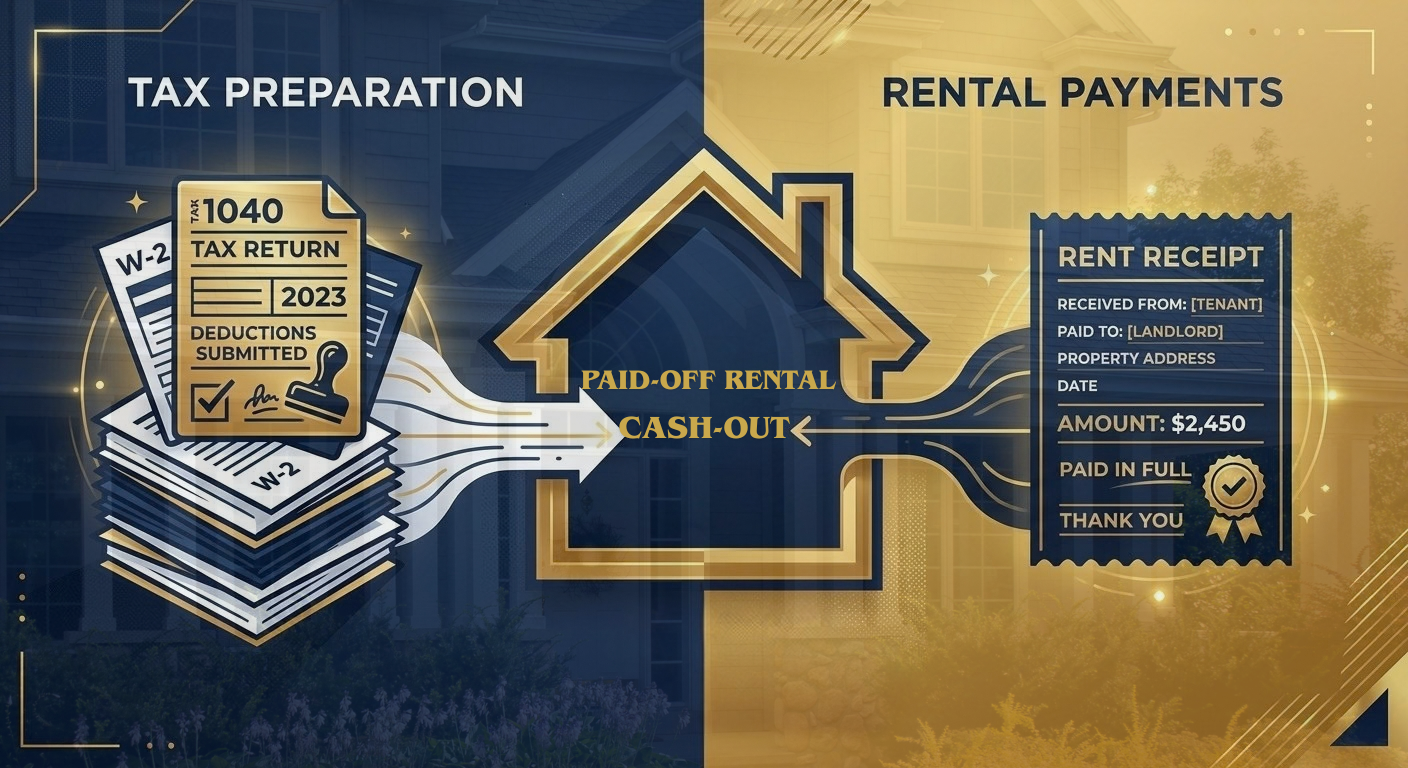
Paid-Off Rental, Cash-Out Refinance: Conventional or DSCR? Run Both Before You Choose
You own it free and clear. Two very different loans can pull the equity out. One is cheaper. One is easier. Here is how to know which is which for you.
You paid off a rental, or you bought it with cash, and now it sits there with a lot of equity doing nothing. You would like to put that money to work on the next property. Then you start asking around and hear two completely different answers.
One lender says run it conventional, because the rate is better. Another says do a DSCR loan, because there is no income paperwork. Both are right, for different borrowers, and picking the wrong one can cost you real money or a month of frustration.
Here is how the two compare in plain English, plus a calculator so you can see your own numbers side by side.
Own a rental free and clear?
Send me the address and what you want to do with the cash. I will price conventional and DSCR side by side so you can see the real difference.
Price Both Options For MeThe Core Difference: Who Gets Underwritten
A conventional loan underwrites you. Your income, your tax returns, your other debts, and how many properties you already finance all matter. A DSCR loan underwrites the property. The question is whether the rent covers the payment, not what you earn at your day job.
| Factor | Conventional cash-out | DSCR cash-out |
|---|---|---|
| What qualifies you | Personal income and debt-to-income | Rent versus the full payment (the DSCR ratio) |
| Paperwork | Tax returns, W-2s or business returns, pay stubs, bank statements | Lease or market rent appraisal, entity docs, bank statements for reserves |
| Typical rate | Lower | Higher, often by a meaningful margin |
| Typical max leverage | Often around 70 to 75 percent on a rental | Often up to 75 or 80 percent, depending on credit and ratio |
| Can close in an LLC | Usually no, closes in your personal name | Usually yes |
| Prepayment penalty | Typically none | Commonly a 3 to 5 year step-down |
| Limit on number of financed properties | Yes, conventional programs cap it | Generally no personal cap |
Those are typical ranges, not promises. Every lender sets its own matrix, which is exactly why pricing both matters.
When Conventional Wins
If you have steady W-2 income or clean tax returns, a low debt-to-income ratio, and fewer than the cap of financed properties, conventional is often the cheaper path. The lower rate compounds over the life of the loan, and no prepay penalty means you can refinance again whenever rates fall.
It is not unusual for a conventional cash-out to beat every DSCR option on rate, cash to borrower, and total cost, even when the borrower assumed DSCR was the better fit. That is why the first move is to test it, not assume.
When DSCR Wins
- Your tax returns do not show your real income. Write-offs are legal, but they shrink the number a conventional underwriter sees.
- You already own several financed properties and are near the conventional limit.
- You want the loan in an LLC for liability and bookkeeping reasons.
- Speed matters. Fewer income documents means fewer places for a file to stall.
- The property has strong rent. A solid ratio can offset a higher rate if the cash is going to work harder elsewhere.
Not sure which side you are on? Start a scenario review
Side-by-Side Payment and Ratio Check
Use rates you have been quoted. Payments assume a 30-year fixed.
Ready to see what your equity can do?
Tell me the property and your goal. I will show you both paths with real numbers and recommend the one that fits, even if it is not the one that pays me more.
Schedule My Cash-Out Strategy CallConventional vs DSCR Cash-Out: Common Questions
Can I do a cash-out refinance on a rental I own free and clear?
Yes. A property with no mortgage is a common candidate for either a conventional or DSCR cash-out, subject to the maximum loan-to-value, an appraisal, and your credit profile.
Is a DSCR loan always more expensive than a conventional loan?
The rate is usually higher, but the total picture includes paperwork, speed, entity vesting, and prepayment terms. Price both, because the gap varies by lender, credit score, and ratio.
What DSCR ratio do I need for a cash-out refinance?
Many programs look for 1.0 or higher, meaning the rent at least covers the full payment. Some allow lower ratios with adjustments, and a stronger ratio generally improves pricing.
Does a conventional cash-out require tax returns on a rental?
Typically yes. Conventional programs underwrite your personal income, so expect to document it. Rental income from the property can sometimes be counted, using the lender’s calculation.
Can I refinance a DSCR loan into a conventional loan later?
Often yes, if you qualify on income at that time and any prepayment period has run out. Check your note’s penalty schedule before planning the exit.