
Moving for a New Job or New Chapter? How to Keep Your Current Home as a Rental Without Losing Your Shot at the Next One
Relocating doesn’t have to mean selling. Here’s how to turn your current home into an income property while still qualifying for the next one.
A job offer, a new chapter, a reason to relocate — and suddenly you’re staring at the house you’re in and wondering whether selling is really the only move. For a lot of people it isn’t. If your current home has decent equity, a good rate, or just sits in a strong rental market, keeping it and buying your next home can put you ahead in ways selling never would.
The catch is financing both at once isn’t automatic. Lenders have real rules about occupancy, about how (or whether) your current mortgage payment counts against you when you’re trying to qualify for a new one, and about what happens to your existing loan once the home becomes a rental instead of your primary residence.
Here’s how to think through sell-versus-keep, the two main financing paths depending on your situation, and the math that tells you whether keeping it actually pencils out.
Weighing selling vs. keeping your current home?
Relocating is a lot to manage at once. Let’s run the actual numbers on keeping your current home as a rental — including whether it helps or hurts your ability to qualify for the next one.
Run My Numbers Before I DecideSell or Keep? The Real Decision Factors
| Factor | Leans Toward Selling | Leans Toward Keeping |
|---|---|---|
| Current rate | Rate is at or above today’s market rate | Rate is meaningfully below today’s market rate |
| Equity position | Minimal equity, or you need proceeds for the next down payment | Solid equity, and you can fund the next purchase without it |
| Local rental market | Rents in the area are soft or vacancy is high | Rents comfortably cover the mortgage plus a cushion |
| Property condition & type | Home needs significant work to be rent-ready | Move-in ready, low-maintenance, or easy to prep |
| Your appetite for landlording | You’d rather not manage a property remotely | You’re comfortable self-managing or hiring a property manager |
Two Financing Paths, Depending on Your Situation
Path 1: Keep Your Existing Loan, Count the Future Rent
If your current mortgage has a great rate or terms you don’t want to disturb, this is often the cleanest route. Many loan programs allow a portion of the anticipated rental income from your departing residence to offset (or in some cases fully replace) that mortgage payment when calculating your debt-to-income ratio for the new home purchase — typically requiring a signed lease and, depending on the program, a minimum equity position in the current home. This lets your current mortgage payment stop working against you when qualifying for the next one.
Path 2: DSCR Refinance the Current Home
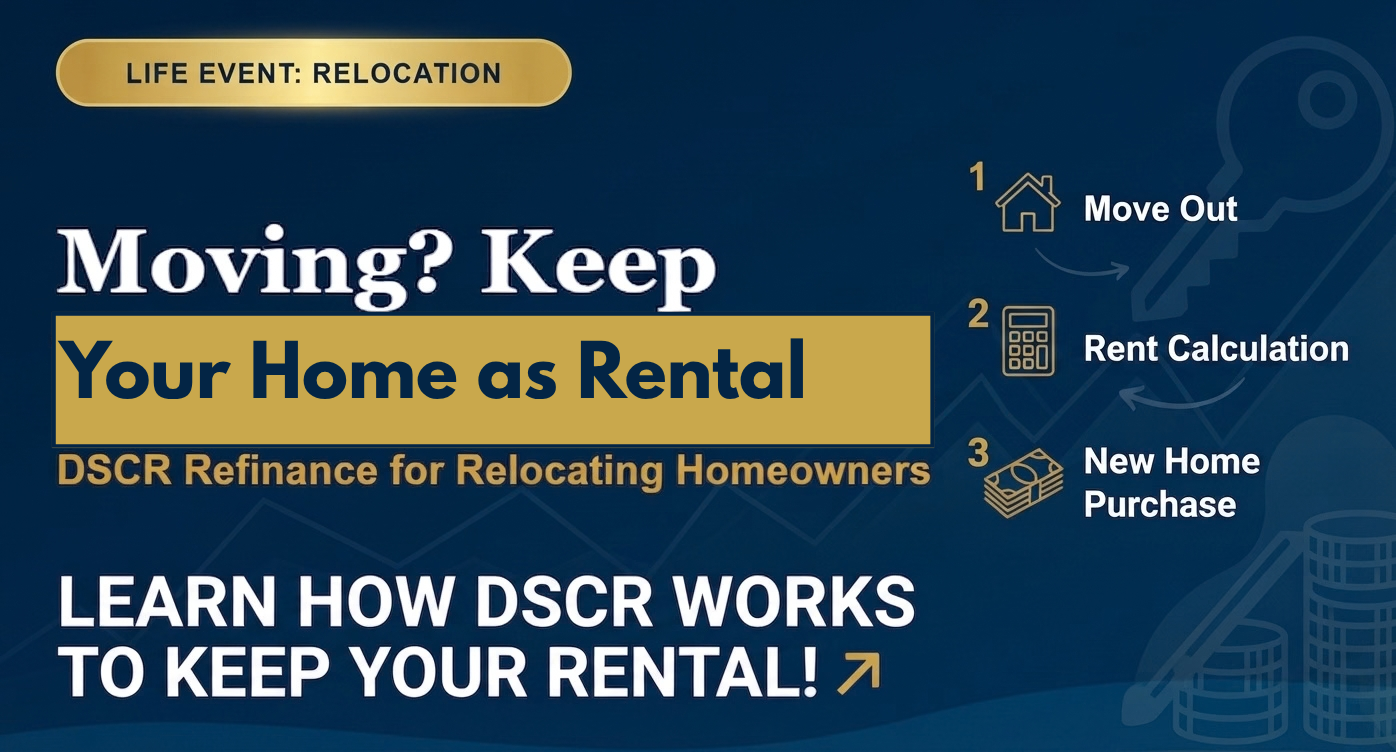
If you want to pull cash out for the move or the next down payment, if your current loan doesn’t fit this plan, or if you’d rather simplify the underwriting entirely, a DSCR (Debt Service Coverage Ratio) refinance converts your departing residence into a financed rental property based on what it can rent for — not your personal income or the future-rent-offset calculation above. This can be especially useful if your income situation is complex, if you want cash out for the transition, or if you’d simply rather keep your two properties’ financing cleanly separated.
Keep-It-as-a-Rental Calculator
See if the numbers support keeping your current home as a rental.
Two Occupancy Rules Worth Knowing Before You Sign Anything
If your current loan was originated as an owner-occupied (“primary residence”) mortgage, most loan agreements include an occupancy clause requiring you to live there for a minimum period — commonly around 12 months — before converting it to a rental, unless the change is due to a genuine change in circumstances, which a job relocation typically qualifies as. This is rarely a problem for a documented move, but it’s worth confirming with your current loan’s terms rather than assuming.
Second, if you plan to buy your next home with as little as 5-10% down using owner-occupied financing again, the lender will generally expect that home to actually be your primary residence — meaning you can’t simultaneously claim owner-occupied status on two properties without a legitimate reason like relocation distance. This is standard, not a red flag, but it’s part of why documenting the move (new job offer, lease agreement on the departing home, distance from the old home) matters.
Common Mistakes That Cost Movers Money
- Listing the home for sale, then changing your mind mid-process without adjusting financing plans — this can complicate both the current listing and the new purchase.
- Not getting a lease signed before closing on the new home if you’re relying on future rental income to help you qualify — many programs require it in hand at underwriting.
- Underestimating vacancy and maintenance when running the rental numbers — the calculator above builds in a 10% cushion for exactly this reason.
- Assuming your current loan servicer needs to approve the rental conversion — in most cases they don’t, but check your specific loan’s occupancy clause to be sure.
Relocating soon? Let’s map both properties at once.
Whether you keep your current home as a rental or refinance it with a DSCR loan, we’ll coordinate the financing on both sides of your move so nothing stalls your timeline.
Coordinate My Move & FinancingRelocating & Rental Conversion: Common Questions
Can I really count future rental income to help me qualify for my next home?
In many cases, yes — a portion of the anticipated rent from your departing residence can offset that mortgage payment in your debt-to-income calculation, typically requiring a signed lease and adequate equity in the current home. The exact requirements vary by loan program, so this is worth confirming with your specific scenario.
What’s a DSCR loan and how is it different from just keeping my current mortgage?
A DSCR (Debt Service Coverage Ratio) loan qualifies based on the property’s rental income compared to its carrying costs — not your personal income at all. It’s most useful when you want to pull cash out, when your income situation is complex, or when you’d rather not rely on the future-rent-offset calculation on your existing loan.
Do I have to tell my current lender I’m converting my home to a rental?
If your loan has an owner-occupancy requirement (common on many primary-residence loans), review your loan documents — most include an exception for a genuine change in circumstances like a job relocation, but it’s worth confirming rather than assuming.
Can I buy my next home with a low down payment if I already own a home I’m keeping as a rental?
Generally yes, provided the new home is genuinely going to be your primary residence — lenders typically want documentation supporting the move, like a new job offer or the distance between the two homes.
What if the rental numbers on my current home don’t actually work?
That’s exactly what the calculator above is for — running real numbers before you commit either way. If it doesn’t pencil out as a rental, selling and rolling the equity into your next home may be the stronger move, and we’ll walk through that math with you too.