

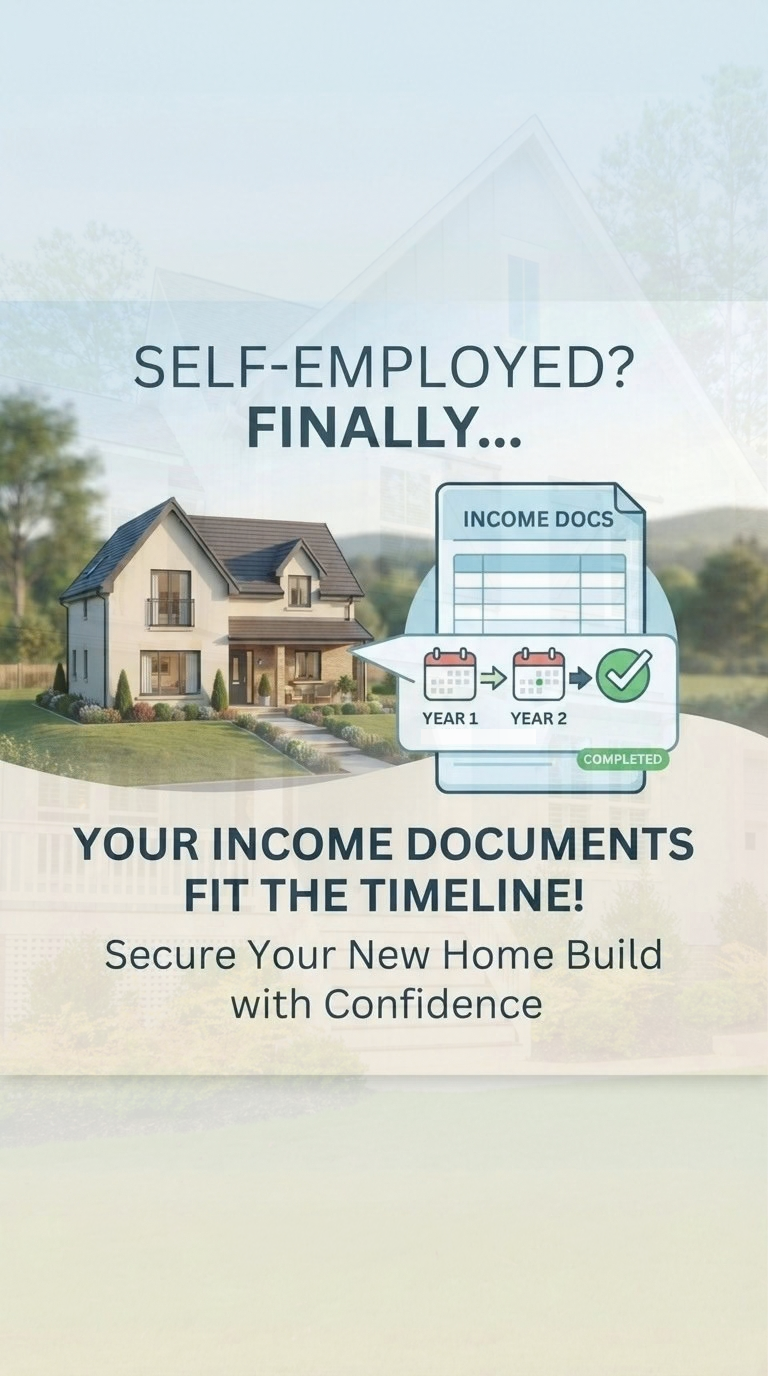
Denied for a New Construction Home Because You’re Self-Employed? Here’s the Fix
Builder deposits are nonrefundable on a timeline. A denial near closing shouldn’t be the moment you find out your income documentation was the problem.
Here’s a situation that happens more often than it should: a self-employed buyer gets pre-qualified, puts down a deposit on a new-construction home, and watches the build go up over several months — only to find out near closing that their income doesn’t fit the lender’s conventional underwriting after all.
By then, real money and real time are on the line. Builder deposits are often substantial and non-refundable past certain contract deadlines, and a denial close to closing can feel like it’s come out of nowhere, even though the real issue was documentable from day one.
If this is happening to you right now, or you want to avoid it before it happens, here’s what’s actually going on and what fixes it.
Worried your new construction loan might not close?
If you’re self-employed and a new-construction closing is approaching, don’t wait for a denial letter to find out. Let’s check your file against the right program now.
Review My New Construction FinancingWhy New Construction Underwriting Trips Up Self-Employed Buyers
A resale purchase typically closes in 30-45 days. A new-construction build can take 8-12 months or longer. That gap matters more than most buyers realize:
- Tax returns can “age out.” If your pre-qualification was based on returns that are now a year older by the time the home is finished, a lender may require updated returns, and a new tax year can change your qualifying numbers entirely.
- Write-offs do their job on taxes, not on you. The same deductions that reduce your tax bill reduce your adjusted gross income on paper, which is exactly what conventional underwriting measures.
- A builder’s “preferred lender” isn’t always the most flexible one. Builders often incentivize using their in-house or preferred lender, but that lender may run strictly conventional underwriting with little flexibility for self-employed income.
Bank Statement vs. P&L: Which Fits a Builder Timeline Better
| Program | How It Documents Income | Fits Best When |
|---|---|---|
| Bank Statement Loan | 12-24 months of actual bank deposits | You have strong, consistent deposit history and some lead time before closing |
| P&L Only Loan | A profit and loss statement signed by your CPA or tax preparer | You have a newer business, or want to avoid submitting a full deposit history |
Both can often be arranged in parallel with an ongoing build, which is exactly why addressing this early — ideally the moment you sign a builder contract, not near your closing date — gives you real options instead of a scramble.
Self-Employed New Construction Qualification Estimator
A simplified illustration of how bank statement income compares to your contract price.
Protecting Your Builder Deposit While You Get Re-Qualified
- Read your builder contract’s financing contingency language now — not after a denial. Many contracts have strict deadlines for securing financing, after which your deposit may become non-refundable regardless of the reason.
- Get a second opinion from a broker who works with self-employed borrowers regularly, ideally before your builder’s lender issues a final denial — a parallel pre-qualification under a bank statement or P&L program can be running in the background the whole time.
- Don’t wait for the builder’s lender to say no before exploring other options — by the time a formal denial happens, you may be closer to your contract’s financing deadline than you’d like.
Mid-build and worried about financing? Let’s talk now.
Whether you haven’t started the loan process yet or you’re facing pushback from a builder’s preferred lender, I can tell you quickly whether a bank statement or P&L program fits your timeline.
Schedule My Self-Employed Scenario ReviewSelf-Employed New Construction Financing: Common Questions
Can I switch lenders if the builder’s preferred lender declines me?
Generally yes — you’re usually not contractually required to use the builder’s preferred lender, though some builders offer incentives (closing cost credits, upgrades) for using theirs. Review your contract, and don’t let an incentive keep you tied to a lender that can’t make your file work.
Will I lose my deposit if my original lender denies me?
It depends on your builder contract’s financing contingency terms and deadlines — this is worth reading closely and acting on early, since many contracts have specific windows for securing financing before a deposit becomes non-refundable.
Do bank statement loans work specifically on new construction, not just resale?
Yes — bank statement and P&L programs qualify the borrower’s income, not the property type, so they apply to new construction the same way they apply to a resale purchase.
How far in advance should I get re-qualified before my closing date?
As early as possible, and ideally the moment you sense any friction with your current lender — new construction timelines leave more room to fix an income documentation problem than a 30-day resale closing does, but only if you start before you’re up against the deadline.
Does using a different lender than the builder’s preferred one affect my purchase contract?
It shouldn’t affect the purchase contract itself, though it’s worth confirming any builder incentives tied to their preferred lender don’t disappear — that’s a cost-benefit conversation worth having directly with your builder.