
CDD and HOA Fees in Florida: How They Shrink Your Mortgage Approval and How to Plan for It
You found the perfect new-construction community. Then the monthly fees nobody mentioned cut your buying power. Here is how to see it first.
You tour a gorgeous new community. The model home is perfect, the amenities are great, and the price fits. Then, somewhere in the paperwork, you notice an extra amount on the tax bill and a monthly HOA fee.
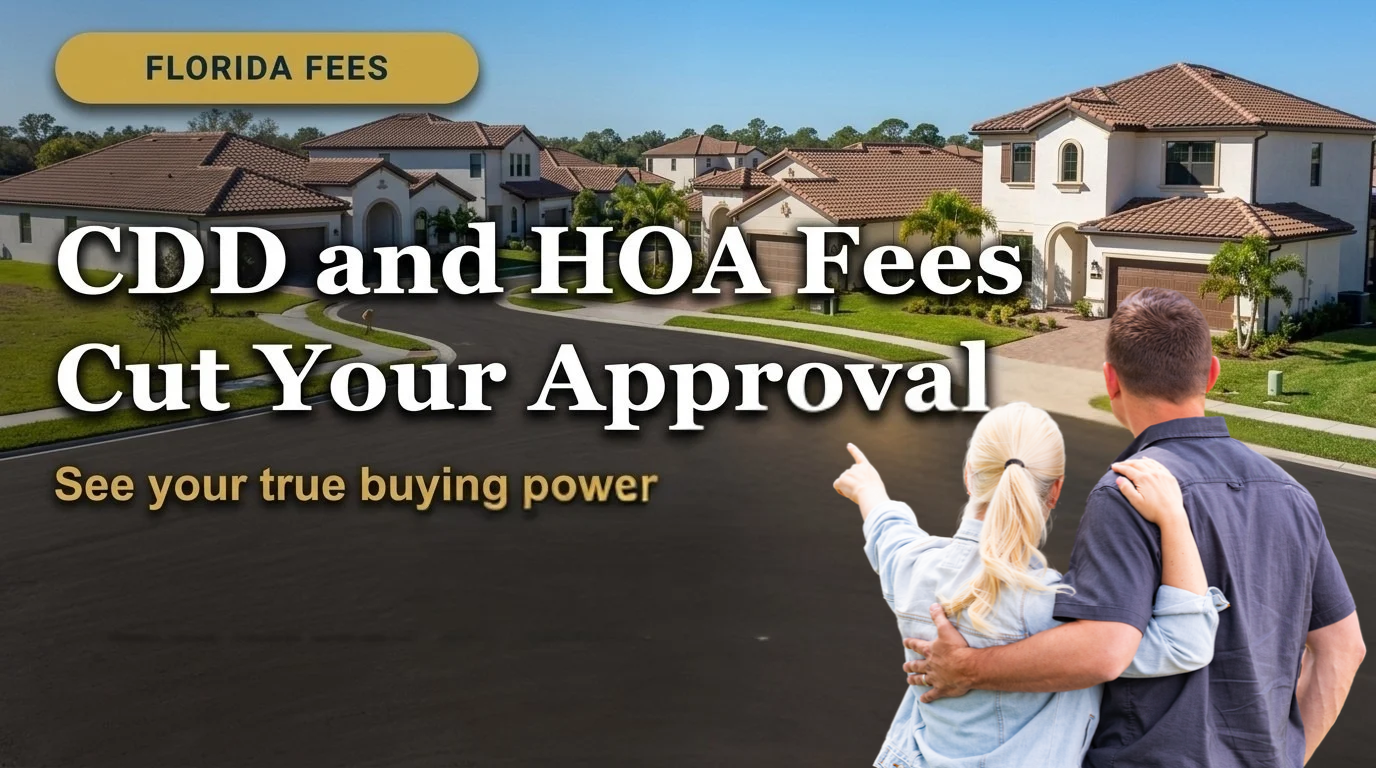
Those two lines are small enough to ignore and big enough to change your approval. Lenders count them as part of your housing payment, which means every dollar of fees can reduce the loan you qualify for.
This is the part of Florida home buying that rarely gets explained up front. Let’s fix that, and give you a calculator to see the impact on your own numbers.
Eyeing a community with CDD or HOA fees?
Send me the address or community name. I will run your approval with the real fees included, before you commit.
Run My Approval With FeesWhat a CDD Is, in Plain English
A Community Development District is a special local government that builds and maintains things like roads, drainage, entry features and amenities in a community. Instead of the developer paying for everything up front, the cost is financed with bonds, and homeowners repay them through a non-ad valorem assessment on the annual property tax bill.
- It shows up on your tax bill, not your HOA statement, which is why it gets missed in listing summaries.
- The bond portion typically runs 20 to 30 years, then drops off. The operations and maintenance portion usually continues.
- Lenders usually escrow it, so it becomes part of your monthly payment.
An HOA is separate. It collects dues for community rules, common areas and amenities, and it is billed directly. Many communities have both.
How Fees Shrink Your Buying Power
Lenders limit your total monthly debts as a share of your income, called the debt-to-income ratio. Your housing payment includes principal, interest, taxes, insurance, HOA and CDD. When fees take a bigger share of that budget, less is left for principal and interest, and that lowers your maximum loan.
A rough rule of thumb: every $100 of monthly fees can reduce your loan by roughly $14,000 to $16,000 at current rates. The exact amount depends on your rate and your limit, which is why the calculator below matters.
CDD and HOA Buying Power Calculator
Estimates only. Your lender sets the actual limits.
Want your approval run with the real numbers? Start a scenario review
Questions to Ask Before You Fall in Love With a Community
0 of 8 complete
None of this means a community with fees is a bad choice. Many are wonderful places to live. It means you should choose with the real monthly number in hand.
Ready to shop with your true buying power?
I will run your numbers with every fee included and tell you the price range that keeps you comfortable.
Schedule My Buying Power ReviewCDD and HOA Fees: Common Questions
What is a CDD fee in Florida?
A CDD fee is a non-ad valorem assessment on your property tax bill that repays bonds used to build and maintain a community’s infrastructure and sometimes amenities.
Do lenders count CDD and HOA fees in my debt-to-income ratio?
Yes. They are part of your monthly housing expense, so they reduce the loan you can qualify for. Lenders typically escrow the CDD with your taxes.
How long do I pay a CDD?
The bond portion typically runs about 20 to 30 years and then drops off the bill. The operations and maintenance portion usually continues for as long as the district operates.
How do I find the exact CDD amount?
Check the county tax bill’s non-ad valorem section and ask what year the bond was issued. Listing summaries can be incomplete.
Can I pay off a CDD early?
In many districts you can pay off the bond portion, but terms vary. Ask the district, and weigh it against other uses of your money.
Does a new home’s property tax change after I buy it?
Often yes. Taxes can reset to reflect the purchase price, so ask your lender to estimate with the new assessed value, not the seller’s old bill.