

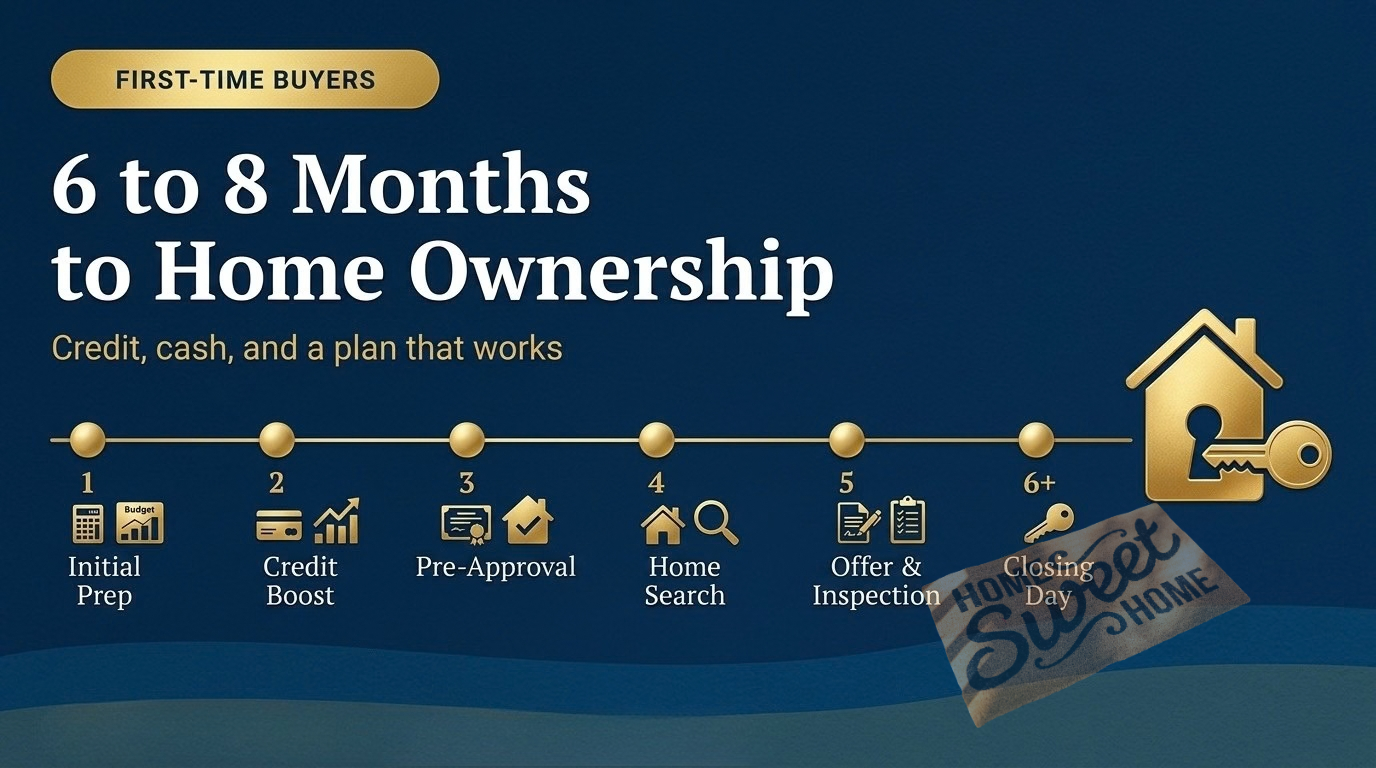
Want to Buy a Home in 6 to 8 Months? Your Month-by-Month Mortgage Roadmap
You do not need to be ready today. You need a plan for the next six to eight months. Here it is, with a checklist and a savings timeline.
Some of the best buyers I talk to are not ready to buy today. They are six to eight months out, they know it, and they want to use that time well instead of wasting it worrying.
That window is a gift. It is long enough to move a credit score, build a down payment, finish a homebuyer course, and show a clean employment history. It is short enough that you will actually stay motivated.
Here is the order I would do things in, so every month moves you closer to a yes.
Buying in 6 to 8 months?
Let’s look at your credit and numbers now, so the next few months are a plan and not a guess.
Start My RoadmapThe Month-by-Month Roadmap
| When | What to do | Why it matters |
|---|---|---|
| Months 8 to 7 | Review credit with your mortgage broker, gather two years of work history, and set a target price range | You see problems while there is still time to fix them |
| Months 6 to 5 | Pay down credit card balances, dispute errors, and keep accounts open and current | Utilization and payment history move scores fastest |
| Months 5 to 4 | Complete a HUD-approved homebuyer course if you may use down payment assistance | Most assistance programs require it before closing |
| Months 4 to 3 | Get fully pre-approved with documents reviewed, not just a quick estimate | Sellers take a documented approval seriously |
| Months 3 to 2 | Build cash for down payment, closing costs, and reserves | Florida closing costs and prepaids add up |
| Final stretch | Shop, offer, inspect, lock your rate, and close. Do not open new credit or change jobs. | New debt or a job change can undo an approval |
Your Readiness Checklist
Tap each item as you finish it. The bar fills as you go.
0 of 10 complete
Stuck on an item? Let’s tackle it together
How Much Cash Will You Actually Need?
A lot of buyers plan for the down payment and forget closing costs, prepaid taxes and insurance, and a reserve. Use this to see how long your savings runway is.
Savings Timeline Calculator
Down payment assistance, seller credits, and gift funds can shrink the gap. Which ones apply depends on your income, location, and loan type, which is exactly what we sort out in the first two months.
The Mistakes That Cost Buyers the Most
- Financing furniture or a car before closing. A new payment changes your debt-to-income ratio overnight.
- Changing jobs mid-process. Especially a move from salary to commission or self-employment.
- Moving money around. Large unexplained deposits must be sourced and documented.
- Closing credit cards. It can lower your score by raising utilization and shortening history.
- Skipping the full pre-approval. A soft-pull estimate is a start, not a commitment.
Ready to turn the next six months into a plan?
I will review your credit and numbers, tell you exactly what to work on, and check back in as you go. No pressure, no jargon.
Book My Free Planning CallBuying a Home in 6 to 8 Months: Common Questions
Is 6 to 8 months enough time to improve my credit?
Often yes. Paying balances down and correcting errors can move scores within one or two billing cycles. Rebuilding after serious events takes longer, which is why starting with a review matters.
What is the difference between a soft pull and a pre-approval?
A soft pull lets a lender estimate your qualification without affecting your score. A full pre-approval reviews your documents and requires a hard credit inquiry, so it carries more weight with sellers.
How much do I need to put down?
It depends on the loan. Some programs allow as little as 3 to 3.5 percent down, some allow zero down for eligible buyers, and assistance programs may cover part of it. Closing costs and reserves are separate.
Should I pay off all my debt before applying?
Not necessarily. Reducing credit card balances helps most, but draining your savings to pay off a low-rate loan can leave you short for closing. We look at your whole picture.
Can I change jobs while I am saving for a home?
Staying in the same line of work helps. A move to a higher-paying job in the same field is often fine, but a switch to self-employment or commission can add documentation requirements. Talk to us before you accept.